
Updated in June 2026
Geoffroy proves it to you in every LinkedIn post, our clients in their testimonials, and the media in their articles: Spain is now one of the most dynamic real estate markets in Europe. Prices have risen by more than 13% in one year (Tinsa, Q4 2025), gross rental yields range from 6% to 9% depending on the area and type of lease, and rental demand remains structurally tight due to insufficient supply. For a foreign investor, building a real estate portfolio in Spain is no longer a niche idea : it is a full-fledged wealth-building strategy.
But expanding from 1 to 10 properties isn’t something you can just wing. Each milestone raises new questions: What purchase vehicle should you use? When should you delegate rental management? How should you structure financing to maintain profitability? And what tax rules apply depending on your country of residence?
This Terreta Spain guide walks you through the process step by step, from purchasing your first property to managing a portfolio of ten properties.
Key Takeaways
Key Takeaways
According to Idealista, the average gross rental yield in Spain ranged from 6.9% to 7.2% in 2025.
- Mortgage financing is available to non-residents: LTV up to 70% for EU residents, 60% for non-EU/EEA residents
- Fixed rate for 2026 for non-residents: 3% to 5%, depending on the borrower's profile and the bank. More favorable terms may be available through a specialized broker
- The IRNR applies to all non-resident property owners: 19% on net income (EU/EEA) or 24% on gross income (non-EU/EEA)
- Outsourced rental management is essential for any non-resident investor, starting with their very first property. The market rate generally ranges from 8% to 12% of the rent collected; at Terreta Spain, the fee is 10% (excluding tax) of the monthly rent for a standard rental property, or €60 (excluding tax) per room for a shared apartment, with an initial listing fee of 1 month’s rent (excluding tax).
- A sole proprietorship is suitable for up to 3–4 assets; beyond that, a corporate structure (limited liability company, real estate investment company, holding company) should be considered
- Investors outside the EU/EEA are legally required to appoint a tax representative in Spain (Art. 10, Ley IRNR)
- According to Idealista, the average gross rental yield in Spain ranged from 6.9% to 7.2% in 2025.
- Mortgage financing is available to non-residents: LTV up to 70% for EU residents, 60% for non-EU/EEA residents
- Fixed rate for 2026 for non-residents: 3% to 5%, depending on the borrower's profile and the bank. More favorable terms may be available through a specialized broker
- The IRNR applies to all non-resident property owners: 19% of net income (EU/EEA) or 24% of gross income (non-EU/EEA)
- Outsourced rental management is essential for any non-resident investor, starting with their very first property. The market rate generally ranges from 8% to 12% of the rent collected; at Terreta Spain, the fee is 10% (excluding tax) of the monthly rent for a standard rental property, or €60 (excluding tax) per room for a shared rental, with an initial listing fee of one month’s rent (excluding tax).
- A sole proprietorship is suitable for up to 3–4 assets; beyond that, a corporate structure (limited liability company, real estate investment company, holding company) should be considered
- Investors from outside the EU/EEA are legally required to appoint a tax representative in Spain (Art. 10, Ley IRNR)
Laying the Groundwork: Buying Your First Property in Spain
What type of property should you choose?
For a first investment, the golden rule is clarity: a property with clearly identifiable rental demand, in a market you understand. One-bedroom or two-bedroom apartments in college towns or cities with high rental demand (Valencia, Madrid, Málaga, Alicante) offer the best balance between return on investment, ease of re-letting, and liquidity upon resale.
In Valencia specifically, the neighborhoods of Ruzafa, Benimaclet, Cabanyal, and Patraix offer attractive investment opportunities: strong rental demand (students, expats, digital nomads), prices still below those of major European capitals, and real appreciation potential. A student studio in Burjassot can be purchased starting at €90,000, and an entry-level apartment in Paterna starting at €95,000. In Benimaclet, expect to pay at least €175,000 for a one-bedroom apartment; the average price per square meter there is projected to exceed €3,300 in 2026. In Ruzafa, prices start around €250,000 for small units in need of renovation.
Are you planning to buy a property in Spain? Talk to a Terreta Spain expert.
Calculate the return on investment from the very first investment
Before making any purchase, two key questions must be clearly addressed:
- Gross Return = (annual rent / total purchase price) × 100
- Net Return = (annual rent – annual expenses) / total purchase price × 100
Expenses to be included are:
- The IBI (Spanish property tax, ranging from 0.4% to 1.1% of the assessed value)
- Condominium Fees
- Home Insurance
- Rental management fees if management is outsourced (typically 8 to 12 percent of the rent)
- And the IRNR (nonresident income tax).
In Valencia, the average gross yield stands at 6.4% (see our comprehensive report: Valencia’s Most Profitable Districts and Neighborhoods: Prices, Rents, Yields). In the outskirts (Burjassot, Paterna, Mislata), some properties yield 8 to 10%. In prime neighborhoods (Ruzafa, Ciutat Vella), gross yields tend to range between 4% and 5%, with greater potential for capital appreciation. The net yield is generally 1.5 to 2.5 percentage points lower than the advertised gross yield—a difference that should be factored in during the analysis phase.
Acquisition Costs to Anticipate
For an older property (which accounts for the majority of rental investments), the costs break down as follows:
- ITP (Impuesto sobre Transmisiones Patrimoniales): 10% in the Valencian Community
- Notary and registration fees: approximately 1 to 1.5%
- Attorney or administrator fees: 1 to 1.5%
Total: Expect ancillary costs to amount to about 12 to 13 percent of the purchase price. These costs are not financed by the bank and must be covered by your down payment.
To get an even clearer picture, check out our article and our calculator:“Costs Associated with Buying Real Estate in Spain”
What is the best way to make your first real estate investment in Spain?
At this stage, purchasing in one’s own name is the norm in the overwhelming majority of cases. The reason is simple: setting up a legal structure (a Spanish SL, a French SCI, or a holding company) involves incorporation and management costs that are not justified for a single asset. Taxation under one’s own name remains straightforward, the legal framework is well-defined, and there is maximum flexibility for resale.
Possible exception: If your initial plan includes purchasing 3 or 4 properties quickly from the outset, or if your personal financial situation makes purchasing in your own name fiscally disadvantageous in your country of residence, it may be advisable to plan the structure from the very first purchase. This is a matter to discuss with a wealth and tax advisor before signing the contract.
Essential Formalities
Before making any purchase in Spain, you must have:
- The NIE (Número de Identificación de Extranjero): a mandatory Spanish tax identification number for all real estate transactions
- A Spanish bank account: required for a mortgage, tax withholdings, and day-to-day banking
- A tax representative: required for non-EU residents (see the Taxation section)
Smart Financing: Leverage and Its Impact on Profitability
Mortgage Loans for Non-Residents
Spanish banks are actively lending to non-resident foreign buyers. The terms differ from those offered to residents, but remain accessible to well-prepared buyers.
LTV (Loan-to-Value):
- EU/EEA residents: up to 70% of the property's value
- Non-EU residents: generally 60%; some banks offer up to 70%, depending on the applicant’s profile and collateral
- Spanish residents: up to 80%
Specifically, for a property priced at €200,000, a non-EU resident can borrow up to €140,000 and make a down payment of €60,000, plus 10 to 15 percent in closing costs depending on the region (i.e., €20,000 to €30,000 for a €200,000 property). The total amount required is therefore approximately €80,000 to €90,000.
Rates in 2026:
- Fixed rate for non-residents: between 3% and 5%, depending on the borrower's profile, LTV, and the bank—more favorable terms may be obtained through a specialized broker
- Variable rate: Euribor + 1.5% to 2.5% for non-residents
- Maximum term: 20 to 25 years for non-residents (compared to 30 years for residents)
Maximum debt-to-income ratio: Spanish banks require that total monthly payments not exceed 30 to 35 percent of monthly net income.
Check out our feature:“Mortgages in Spain for Non-Residents.”
How Leverage Improves Profitability
The benefit of a mortgage extends beyond financing: it automatically increases the return on equity. Here’s a simplified example:
- A good buy: €200,000
- Annual rent, excluding expenses: €10,000
- → Net return on the total price: 5%
- With a loan of €140,000 at 3%: annual interest ≈ €4,200
- → Net income after credit ≈ €5,800 on €60,000 invested
- → return on equity: ~9.7%
Leverage works as long as the interest rate on the loan remains lower than the property’s net return, which is the case in most Spanish markets today.
Non-EU Investors: Specific Banking Requirements
For residents of Canada, the United States, the United Arab Emirates, Qatar, or the United Kingdom (post-Brexit), banking requirements are stricter:
- LTV is generally capped at 60%, though some banks may go as high as 70% depending on the borrower’s profile and collateral
- More stringent credit history requirements: 2 to 3 years of tax returns from the country of residence, sometimes translated and apostilled
- The banks most familiar with these profiles: Sabadell International, CaixaBank through HolaBank, and UCI; Bankinter reserves the fixed rate for EU residents
In any case, it is strongly recommended that you work with a mortgage broker who specializes in non-resident clients: they know the right bank contacts, can present your application in accordance with local practices, and can secure terms that you would not be able to obtain by dealing directly with the bank.
Alternatives to Spanish loans
For investors with existing financial assets, other options are available:
- Lombard Loan (or asset-backed financing): Offered by international private banks (Julius Baer, BNP Paribas Wealth Management, HSBC Private Banking), this type of loan allows clients to use financial assets (such as a securities portfolio or life insurance policy) as collateral to finance a real estate purchase, without having to sell the assets. This is suitable for clients with significant assets who wish to maintain their current investment allocation while investing in real estate.
- Refinancing an existing property: If you own a property in your country of residence with significant equity (the difference between the market value and the outstanding loan balance), you can refinance or tap into that equity to buy a property in Spain with cash or a larger down payment.
Are you interested in investing in Spain? Talk to a Terreta Spain expert.

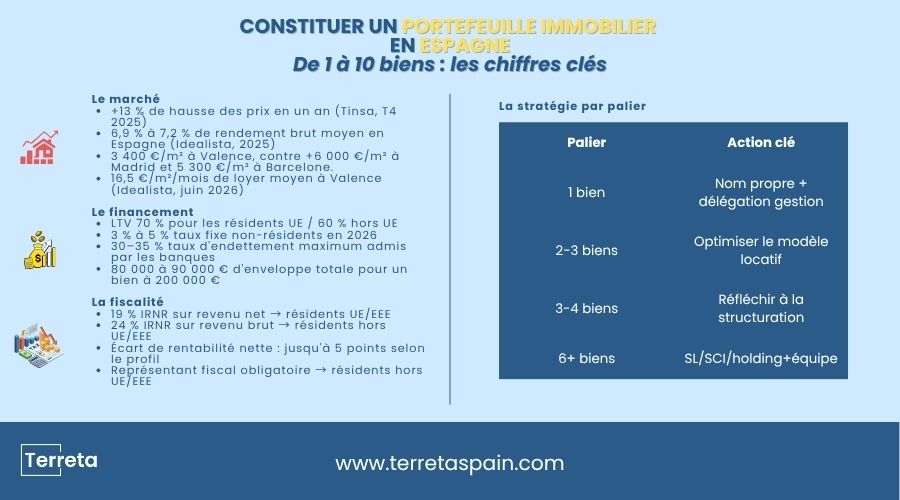
Terreta Spain infographic created with Gemini
1 to 3 properties in Spain: Optimize Before Scaling
Choosing a Rental Strategy
It is at this stage that the bulk of the business model is determined.
Three main options:
Long-term rental (contract of 12 months or more)
This is the safest strategy for a non-resident investor. Gross returns range from 5 to 8% in Valencia, depending on the neighborhood, with predictable rental income and simpler management. In 2026, Spanish law will significantly favor this type of rental: tax deductions of 50 to 90% may apply to net income (subject to conditions in high-demand areas). This is the go-to model for anyone looking to build a solid portfolio without the administrative hassle.
Medium-term leases (contracts ranging from 1 to 11 months)
Student shared housing, digital nomads, and expatriates on temporary assignments: this segment offers a net return comparable to that of short-term rentals, with far fewer regulatory complexities. In Valencia, neighborhoods near universities (Benimaclet, Burjassot) are particularly well-suited. Since 2026, Terreta Spain has been recommending this approach in prime neighborhoods as an effective alternative to short-term rentals.
Vacation Rental (Short-Term)
The gross return can exceed 10% in certain neighborhoods, but regulatory requirements have become stricter. As of July 2, 2025, any property owner wishing to rent out a property for short-term stays in the Valencian Community must obtain a registration number from the Registro Único de Arrendamientos Turísticos, following approval by the homeowners’ association and the city hall (Decree-Law 9/2024). Without a valid license, tourist rentals are illegal. This is a critical factor to consider in your pre-purchase analysis.
For more information: How do I obtain the Rental Registration Number?
Why Delegate Property Management Starting with Your First Real Estate Investment in Spain
Outsourcing property management is often viewed as a cost. In reality, it is a prerequisite for non-resident investors.
A local property manager (agency or management company) handles the following: listing the property for rent, selecting tenants, signing leases, collecting rent, managing routine repairs, ensuring compliance with legal requirements, and reporting back to the owner. For an investor based in Paris, Geneva, or Dubai, this is literally the difference between an investment that runs on its own and one that has you getting a call in the middle of the night because of a water leak.
The cost of property management: between 8% and 12% of rental income, depending on the level of service. This expense is tax-deductible for EU/EEA residents. It must be included in the calculation of the net return from the analysis phase onward and should not be treated as an optional variable.
As soon as you have two or three properties, delegating is no longer an option—it becomes a necessity to maintain the quality of management and avoid mistakes (unreported rent delays, overlooked repairs, missed IRNR filings).
Our team offers a turnkey service that includes property search, renovation, leasing, and rental management, allowing investors to manage their portfolio remotely without having to treat it as a second job.
Taxation of Rental Income Based on Your Profile
Investors who are residents of the EU/EEA (France, Belgium, Switzerland, Norway, etc.):
You are taxed at a rate of 19% on your net income under the IRNR (Impuesto sobre la Renta de No Residentes), using Form Modelo 210.
Deductible expenses include:
- Loan Interest
- Management Fees
- IBI
- Condominium fees
- Insurance
- Maintenance Work
- Depreciation of the asset.
This deduction can significantly reduce the actual taxable base (Terreta Spain / AEAT, 2026).
Note: Switzerland is subject to the EU rate of 19% under the expanded EEA Agreement. Check your situation with a Spanish tax advisor.
Investors residing outside the EU/EEA (U.S., Canada, Qatar, the United Arab Emirates, the United Kingdom after Brexit, etc.):
The tax rate is 24% on gross income, with no deductions for expenses. This represents a substantial difference from the EU system: while a French investor is taxed at 19% on net income, a British investor is taxed at 24% on gross income, which can result in a difference in net return of 3 to 5 percentage points, depending on the level of expenses.
Common Reporting Requirements:
- Form 210: Annual Declaration of Rental Income (since the 2024 reform, rental income must be reported annually)
- Imputed rent: If the property is not rented, a notional income equal to 1.1% or 2% of the assessed value is taxable each year
- IBI: local property tax, ranging from 0.4% to 1.1% of the assessed value, payable annually
Bilateral tax treaties: Most French-speaking countries (France, Belgium, Switzerland, Canada, Morocco, Senegal, etc.) have signed treaties with Spain to avoid double taxation. Rental income earned in Spain is taxed in Spain and reported in the country of residence, generally with an equivalent tax credit. It is strongly recommended that you consult a Spanish tax advisor to accurately assess your situation.
Mandatory Tax Representative Outside the EU
Investors residing outside the EU/EEA—including those in the United States, Canada, Qatar, the United Arab Emirates, and the United Kingdom (post-Brexit)—are legally required to appoint a tax representative domiciled in Spain (Article 10, Ley IRNR). This professional acts as a point of contact with the Agencia Tributaria, manages IRNR tax returns, and receives tax notifications on their behalf.

What is the best way to purchase 2 or 3 properties in Spain?
For a portfolio of 1 to 3 properties, holding them in your own name is generally the most efficient solution. The question to ask isn’t “Should I set up a legal structure?” but “Do the costs and burdens of a legal structure justify the tax and estate planning benefits it provides?” For 2 or 3 properties generating modest income, the answer is often no.
However, at this stage, it makes sense to start thinking about future planning with a wealth and tax advisor. The right time to make a decision is before the structure becomes an urgent necessity—not after.
Do you have questions about buying real estate in Spain? Talk to a Terreta Spain expert.
3 to 6 properties: Building a Sustainable Structure
When and Why to Switch to a Legal Structure
Once you have 3 or 4 properties, there are several signs that it's time to consider setting up a legal structure:
Annual rental income exceeds €30,000 to €40,000
- Do you want to protect your personal assets from rental liability?
- Do you have any business partners (spouse, children, investment partners)?
- Your goal of passing on your estate is becoming increasingly important
- The tax burden for individuals is significantly higher than for corporations
The Four Vehicles You Should Know About
1. The proper noun (personal purchase)
Simple, with no overhead costs, and direct taxation. Suitable for up to 3–4 properties for most investors.
Limitation: The income is added directly to your personal income in your country of residence, and liability is unlimited.
2. The Spanish Sociedad Limitada (SL)
The Spanish equivalent of the French SARL. It offers limited liability, the ability to deduct operating expenses (salaries, fees, business vehicles if justified), and may be attractive to investors who reinvest their profits rather than distribute them. The corporate tax rate in Spain is 25% (15% for the first two years). It incurs annual administrative costs (accounting, filing financial statements) and requires rigorous bookkeeping. Suitable for investors residing in Spain or wishing to structure a purely Spanish estate.
3. The French SCI
Well known to French investors, it allows for the ownership and transfer of real estate assets while benefiting from French tax rules (income tax or corporate tax, depending on the option chosen). In Spain, a French SCI that owns real estate remains subject to Spanish tax obligations: IRNR on rental income and local reporting requirements. It is suitable for intra-family transfers or the separation of ownership (usufruct/bare ownership), but its structure must be validated by comparing French and Spanish law, which requires dual legal counsel.
4. The Asset Holding Company in Spain
For a substantial portfolio (6 or more properties), a holding company can consolidate multiple structures under a single parent entity, enabling centralized management of cash flows, internal trade-offs (such as selling a subsidiary rather than a property), and optimization of succession planning. This is the structure typically used by professional investors or high-net-worth families. It involves significantly higher setup and maintenance costs and must be structured with the assistance of a tax attorney who is well-versed in both legal systems.
For more information:
- Set up an SL (Sociedad Limitada) for your real estate investments in Spain
- Buying property in Spain through a French SCI
- A French SCI or a Spanish SL: Which Structure Should You Choose for Buying Property in Spain? (link to be added when published)
- Holding Company + Spanish SL: The Structure for Large Portfolios (link to be added when published)
Impact of Vehicles on Net Profitability
The choice of vehicle has a significant impact on profitability.
We've put together this table for you as an example:
| Profile | Tax rate | Deductions | Overhead costs |
|---|---|---|---|
| Proper noun – EU resident | 19% of net income | ✓ Yes | None |
| Proper noun – non-EU resident | 24% of gross income | ✗ No | None |
| Spanish SL | 25% of net income | ✓ Yes (wide) | 1,500–3,000 €/year |
| French SCI (IR) | Marginal tax rate in the country of residence | ✓ Yes | 1,000–2,000 €/year |
| French SCI (IS) | 15–25% based on profit | ✓ Yes | 1,500–3,000 €/year |
These figures are for illustrative purposes only. Each investor’s situation depends on their country of residence, their personal marginal tax rate, and the applicable tax treaty.
These figures are for illustrative purposes only. Each investor’s situation depends on their country of residence, their personal marginal tax rate, and the applicable tax treaty.
Property Division and Transfer: Tools You Should Know About
The division of ownership (separation of usufruct and bare ownership) is a powerful estate planning tool recognized under Spanish law as “usufructo/nuda propiedad.” In particular, it allows an individual to transfer bare ownership of a property to their children while retaining the usufruct (and thus rental income) until their death, thereby reducing the taxable estate.
Its application in Spain for French tax residents requires a comparative analysis of the two tax systems and must be structured in collaboration with a specialized firm. Terreta Spain works with the firm Delaguía y Luzón, which has extensive experience with international clients, for this type of structuring.
Practical information:
Delaguía y Luzón website: https://delaguialuzon.com/
Contact email addresses:
felix.delaguia@delaguialuzon.com
sonia.gomezluzon@delaguialuzon.com
Phone: +34 963 74 16 57
Non-EU Investors: Which Structure Is Best in Spain?
For an investor based in the United States, Canada, Qatar, or the United Arab Emirates, the issue of structure is all the more strategic given that the tax regime for individuals (24% on gross income, with no deductions) is disadvantageous. Two options to consider:
- The Spanish SL: allows for the deduction of expenses and taxes only the net profit at a rate of 25%. For significant rental income, this arrangement can be advantageous, provided that the costs of managing the entity are properly factored in.
- The use of a holding company in a third country (Luxembourg, the Netherlands): appropriate for very large estates; this should be discussed with an international tax attorney.
In any case, the tax treaty between Spain and the country of residence is the first document to review.
To learn more, read our articles:
- Holding Company + SL: A Wealth Management Structure for Large Portfolios
- Set up an SL (Sociedad Limitada) for your real estate investments in Spain
- Investing in Real Estate in Spain: Should You Buy in Your Own Name, Through an SL, or Through a SOCIMI?
Diversify to Secure Returns
A portfolio of 3 to 6 properties allows for strategic diversification:
- By property type: combine long-term leases (stable cash flow) with medium-term leases (higher returns, tenant renewals)
- By sector: combine a prime asset (lower return, greater security and appreciation) with an intermediate asset (higher return, slightly higher turnover)
- By city: Valencia for yield, Madrid for long-term capital appreciation, and the Mediterranean coast for its tourism potential, for example.
6 to 10 Properties: Managing a Real Estate Portfolio in Spain Like a Pro
Outsourced rental management is becoming the backbone
At this stage, it is impossible to manage 6, 8, or 10 properties remotely on your own without sacrificing your quality of life or profitability. Delegating to a professional property management firm is no longer an option—it is the foundation upon which the entire portfolio rests.
What you should expect from a manager at this level:
- Monthly reporting by property (rental income, operating expenses, occupancy rate)
- Overall Portfolio Dashboard
- Planning for Maintenance (Preventive Rather Than Corrective)
- Tracking lease renewals and rent adjustments
- Interface with tax software for IRNR tax returns
The cost of the management service varies depending on the service provider and the type of rental. For example, Terreta Spain charges 10% of the monthly rent (excluding tax) for rental management, or €60 (excluding tax) per room for a shared apartment, plus one month’s rent (excluding tax) for the initial rental placement. This expense should be factored into the net return calculation during the analysis phase, just like property tax (IBI) or loan interest.
In practice, our clients who have outsourced management of their first property sleep better—and their occupancy rates are consistently higher than those of clients who manage their properties directly from France.
To learn more, click here.
Do you have a rental property project? Talk to a Terreta Spain expert.
Manage cash flow and reinvest rental income
With a portfolio of 6 to 10 properties, cash flow begins to be significant. You have two strategies to choose from:
- Reinvestment of rent: Net rental income is used to finance the down payment on the next property, creating a “snowball” effect. This is the strategy of investors focused on asset growth, who prefer capital accumulation over income distribution.
- Distribution and Optimization: Net rental income is treated as supplemental income or distributed through the legal structure. This is the strategy adopted by investors in the “harvest” phase, who are often older or have reached their volume targets.
Arbitrage: Selling to Maximize Profits
With 6 or 10 assets, arbitrage (selling an underperforming asset to reinvest in a more profitable one) becomes an active portfolio management tool.
Traditional arbitration criteria:
- A gross yield of less than 5% in a market where yields range from 6% to 8% elsewhere
- Need for major repairs that were not anticipated at the time of purchase
- A neighborhood where the rental market has deteriorated
- Significant unrealized capital gains that can free up capital for a better acquisition
In Spain, the 3% withholding applies at the time of sale: the buyer withholds 3% of the sale price and pays it directly to the Agencia Tributaria. This amount is deducted from the capital gains tax due (19% for non-EU and non-EU residents). This must be factored into the calculation of the net cash proceeds from the sale.
Form 720 and Reporting Requirements Outside the EU
Form 720 is the declaration of foreign assets held by Spanish tax residents. If you become a Spanish tax resident and hold financial or real estate assets abroad exceeding €50,000, this reporting requirement applies (due by March 31 of each year).
For non-EU tax residents who own property in Spain, the opposite applies: your country of residence may require you to report your Spanish assets. The United States (FBAR, FATCA), Canada, and certain Gulf countries have their own reporting requirements for foreign assets; it is essential to check with your local tax advisor.
Building a Real Estate Portfolio in Spain: Surrounding Yourself with a Competent Team
Once you have 5 or 6 properties, managing your portfolio on your own is a strategic mistake. The minimum team you should assemble:
- A Spanish tax advisor (or bilingual firm): handling IRNR tax returns, monitoring local tax obligations
- A Spanish attorney (or law firm): handling acquisitions, leases, and structuring
- A trusted property manager: monthly reports, property maintenance
- A wealth management advisor in your country of residence: coordination with local tax authorities, estate planning strategy
- A specialized mortgage broker: access to the best financing terms for subsequent purchases
Mistakes That Undermine Profitability at Every Stage
Overestimating the gross yield. A gross yield of 7% or 8% says nothing about actual profitability. A property with a 7% gross yield and 3 percentage points in expenses (property tax, management fees, insurance, and IRNR) yields a 4% net return—the same result as a better-optimized property with a 6% gross yield. Always calculate in net terms.
Don’t overlook tax implications based on your profile. An investor outside the EU who expects a net return based on the EU tax regime (19% of net income) may be in for an unpleasant surprise when they discover they’re paying 24% on gross income. The impact can range from 2 to 4 percentage points of net return.
Choosing the wrong vehicle for the purchase. Setting up a Spanish SL for a single property worth €150,000 generates overhead costs that eat into a significant portion of the income. Conversely, waiting until you own 8 properties in your own name before considering a corporate structure creates a complex and costly reorganization challenge. We sometimes see investors who have set up an SL before even signing their first preliminary sales agreement. The result: between €1,500 and €2,000 in annual accounting fees for a single property that generates €5,000 to €7,000 in gross rent. The structure eats into the return.
Neglecting rental management. A poorly managed property leads to rental vacancies, unexpected unpaid rent, and repairs that aren’t reported in a timely manner. For a non-resident investor, this isn’t a minor issue—it’s the difference between a profitable asset and a problematic one.
Don’t forget about Spanish tax returns. The Modelo 210 is required every year, even if the property isn’t rented out. The Hacienda (Spanish tax authority) can go back four years. When selling, the notary will require proof of payment of the IRNR for the last four years: late payments result in fines and interest and can prevent the sale from going through.
Ignoring tourist rental regulations. As of July 2025, operating a tourist rental property without registration in the Registro Único de Arrendamientos Turísticos in the Valencian Community is subject to heavy fines. Check local regulations before making any purchase intended for tourist use.
Investing without an exit strategy. Every property acquired must have a clear investment thesis: for how long? With what objective (return, appreciation, transfer)? The ability to make informed decisions depends on this initial clarity.
Why Valencia Is a Strategic Starting Point for Your Portfolio

Valencia isn’t just a bargain on an Excel spreadsheet. It’s a city where rental demand is driven by genuine underlying trends, and where buying opportunities are still within reach for buyers who would be excluded from the Madrid or Barcelona markets.
- Prices remain affordable. Despite a year-over-year increase of more than 24% (Idealista, March 2026), the average price in the city of Valencia remains around €3,378 per square meter—35 to 40% less than in Madrid (€5,984 per square meter) or Barcelona (€5,243 per square meter). There is still potential for prices to catch up.
- One of the highest rental yields in Spain. Prime neighborhoods offer gross yields exceeding 6%; in the suburbs, some areas reach 8 to 10%. The average rent in the capital of the Valencian Community is €16.5/m²/month as of June 2026 (Idealista).
- Structurally strong rental demand. Valence attracts students (several universities of European standing), expatriates, digital nomads, and French and Belgian families relocating to the area.
- A market that remains underutilized by institutional investors. Unlike Madrid or Barcelona, where real estate funds are very active, Valencia remains a market dominated by individual buyers and private investors, offering greater price transparency and opportunities for negotiation.
- A living environment that makes remote management easier. With a well-established French-speaking community, bilingual professionals (lawyers, managers, tax advisors), and a service infrastructure tailored to non-residents, Valence is one of the easiest cities in which to invest from abroad.
Quality of Life Index in Valencia
Source: Numbeo
Conclusion
Conclusion
Build a real estate portfolio in Spain consisting of 1 to 10 properties
This is a long-term project that is built in stages. Each stage has its own logic: the first property lays the foundation; the first three validate the model; the next three to six require careful structuring; and the final ones are acquired and managed using the tools of a professional investor.
At each stage, three factors determine the portfolio’s actual performance: the quality of the acquisition (location, price, rental potential), the soundness of the financing (controlled leverage, LTV appropriate for the profile), and the quality of the outsourced rental management (reporting, maintenance, tax compliance).
Valencia currently offers a particularly favorable environment for starting and scaling a business. Terreta Spain supports French-speaking investors at every stage of this journey—from finding their first property to managing a mature portfolio.
Talk to an expert at Terreta SpainFAQ
Frequently Asked Questions
Can you buy multiple properties in Spain as a non-resident?
Yes, with no limit on the number. No Spanish law restricts the number of properties a nonresident can purchase. It is the financing capacity, legal structure, and tax obligations that change as purchases are made—not the right to buy.
Do you need to set up a company to invest in real estate in Spain?
No, not necessarily. For 1 to 3 properties, purchasing in your own name is generally the simplest and most efficient option. A legal structure (Spanish SL, French SCI, holding company) is only justified when rental income is significant, when estate planning becomes an issue, or when limited liability is desired. This is a decision that should be made with a bilingual French-Spanish tax advisor, ideally by the time you own your third or fourth property.
What is the difference between a French investor and an American or Qatari investor in Spain?
The main difference is tax-related. An EU/EEA resident pays 19% IRNR on their net rental income (after deductible expenses). A non-EU resident pays 24% on gross income, with no deductions allowed. The actual difference in net profitability can be as high as 3 to 5 percentage points. Non-EU residents are also required to appoint a tax representative in Spain, and their mortgage LTV is capped at 60%, compared to 70% for EU residents.
Is it possible to fully delegate property management from abroad?
Yes, that is precisely the model Terreta Spain recommends for non-resident investors. A local property manager handles the rental process, tenant screening, rent collection, maintenance, and tax compliance (IRNR). At Terreta Spain, rental management is billed at 10% (excluding tax) of the monthly rent for a standard rental property, or €60 (excluding tax) per room for a shared apartment, with an initial listing fee of one month’s rent (excluding tax). This fee is tax-deductible for EU/EEA residents and is factored into the net return calculation from the initial analysis.
What tax obligations apply even if my property isn't rented out?
All non-resident property owners must report a notional income (renta imputada) each year, calculated at 1.1% or 2% of the assessed value, which is taxed at 19% (EU) or 24% (non-EU) using Form 210. Failure to do so may result in penalties and could prevent a future sale: the notary requires proof of IRNR payments for the last four years at the time of the sale.
When should you start planning a wealth transfer strategy?
Ideally, starting with the third or fourth property, and in any case before reaching six assets. The tools available in Spain—separation of ownership (usufructo / nuda propiedad), gifts, and real estate investment companies (SCI) with separation clauses—are effective but must be set up in advance, not as a last-minute measure. Retrospective structuring is possible but costly and more complex.
Can you get a mortgage in Spain if you’re self-employed or an entrepreneur?
Yes, but banks have stricter requirements: 2 to 3 years of financial history, and sometimes a lower LTV (50–60%). A Spanish accountant who prepares the application in accordance with local standards and a mortgage broker specializing in non-residents can make a real difference in this case.
Further information
- The Most Profitable Neighborhoods in Valencia in 2026
- Rental profitability: France vs. Spain
- Real Estate Taxes in Spain: The Complete Guide
- Understanding the IRNR: Requirements, Rates, and Form 210
- Mortgages in Spain
- Investing in Spain with a family office
- Lombard Loan: The Smart Way to Buy Property in Spain Without Selling Your Investments