
Terreta Spain, updated in May 2026
A few weeks ago, Geoffroy Reiser, co-founder of Terreta Spain, answered his phone. On the other end of the line was a family office based in Dubai. The goal? To purchase 35 apartments in Spain within 12 months. This is not an isolated case.
Family offices, whether based in Geneva, Luxembourg, Amsterdam, London, or Dubai, are showing increasing interest in Spanish real estate as an asset class. Why? Because rental yields in Spain are higher than those in Northern Europe, the market is still affordable compared to Paris or London, for example, demographic trends are favorable, and the country is legally stable.
This guide explains how Terreta Spain handles this type of assignment, from identifying properties to managing rentals.
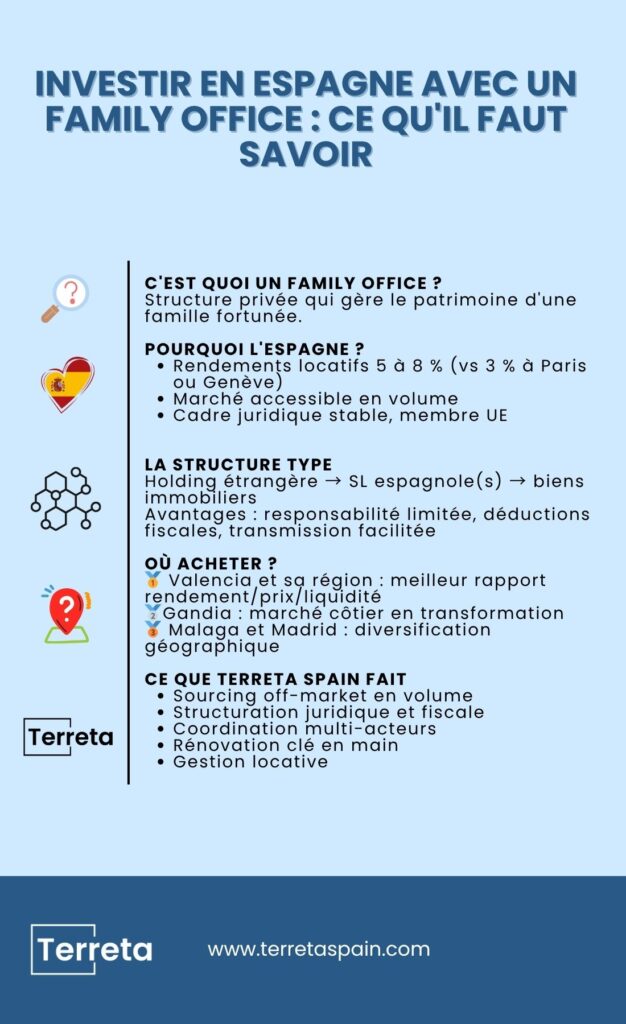
Illustration by Terreta Spain
What is a family office?
A family office is a private entity established to manage the wealth of a high-net-worth family. In practice, it is a dedicated team—sometimes a separate company—that handles everything: financial investments, real estate, tax matters, estate planning, and philanthropy. There are two main types:
- A single-family office, which manages the assets of a single family.
- A multi-family office, which provides shared services to several high-net-worth families.
These structures exist all over the world, but they are concentrated primarily in a few major financial centers: Geneva, Zurich, and Luxembourg in Europe; London, despite Brexit; Singapore and Hong Kong in Asia; and Dubai, which has been growing rapidly over the past five years. That is precisely where Geoffroy’s client came from. The minimum threshold for establishing a family office is generally estimated at between 50 and 100 million euros in assets.
At Terreta Spain, these investors are a natural target: they are looking to diversify their portfolios with European real estate, have the financial means to make large-scale purchases, and need a trusted partner in the Spanish market.

Family offices and corporate acquisitions: the natural connection
A family office almost never purchases property in its own name. The basic rule of wealth management at this level is to always place a legal entity between the family’s assets and the real estate. In practice, this means that a family office purchasing property in Spain will always do so through a company, most often a Spanish SL, a foreign holding company, or a combination of the two.
The reasons are the same as for any corporate investor, but amplified by the scale and the financial stakes:
- Limited liability;
- Tax optimization through deductions for business expenses and depreciation;
- Transfer facilitated by the transfer of shares rather than by a notarial deed;
- A clear distinction between family assets and Spanish assets.
The difference compared to an individual investor lies in the complexity of the structure. A family office often manages a chain of companies: a parent holding company in a tax-friendly jurisdiction (Luxembourg, the Netherlands, Dubai), which owns one or more Spanish SLs, each holding one or more properties. This type of structure requires close coordination between Spanish tax lawyers, the family office’s wealth management advisors, and notaries on both sides. This is exactly what Terreta Spain coordinates on the Spanish side.
Why Spain Attracts Family Offices
You'll see that it makes sense and that the reasons are both cyclical and structural.
- Gross rental yields in cities such as Valencia, Alicante, and Seville range from 5% to 8%, and sometimes higher for flipping or renovation projects, whereas in Paris or Geneva they top out at 3%. For a family office looking to diversify its financial assets into real estate, the math is… simple.
- The Spanish market is also one of the few in Europe that still offers opportunities to purchase residential properties in need of renovation in bulk, particularly in secondary coastal towns and certain urban neighborhoods undergoing redevelopment. This is exactly the type of opportunity that Terreta Spain identifies and secures for its clients.
- Finally, Spain benefits from a clear legal framework, a tax system that is easy for non-EU residents to understand, and a robust notarial market. For a family office accustomed to investing in complex jurisdictions, this is a significant advantage.
Where can I buy property in Spain through a family office?
Location is a key consideration in a large-scale investment mandate. Concentrating 35 apartments in a single city exposes the portfolio to local market risk. The best approach is generally to spread acquisitions across two or three complementary markets, balancing rental income, appreciation potential, and resale liquidity.
Valencia and its surrounding area: our favorite market
Valencia is now one of the most attractive markets in Spain for this type of strategy. Prices remain affordable compared to Madrid or Barcelona, rental yields are among the highest in the country, and rental demand—driven by a large student population and a growing influx of expatriates—is structurally strong. Certain neighborhoods such as Ruzafa, Benimaclet, and Campanar offer particularly attractive opportunities for renovation and value appreciation for a large-scale portfolio.
Read: The Most Profitable Neighborhoods in Valencia in 2026
Beyond the city, the Valencia region offers other attractive opportunities. Gandia, located 70 kilometers south of Valencia, is a coastal destination undergoing rapid transformation, with prices that remain low and strong tourist demand. It is the type of secondary market that complements a portfolio focused on Valencia.
Read: Investing in Gandia: 2025 Guide
Other markets to consider
For family offices looking to diversify geographically beyond the Valencia region, Málaga and Madrid are two complementary markets worth exploring. Málaga offers significant renovation potential for older properties in a rapidly growing market. Madrid, particularly its student neighborhoods, offers a particularly stable demand for long-term rentals.
Read: Renovating in Malaga: A Buyer's Guide
Read: Investing in Madrid's Student Neighborhoods
Our recommendation for a large-scale investment mandate: focus the portfolio on Valencia and the surrounding region, which currently offers the best value in terms of returns, price, and liquidity on the Spanish market, and diversify slightly into Málaga or Madrid depending on the family office’s risk profile .
What Terreta Spain actually does for a family office
For us, a “family office mandate”—as they’re called—is not a traditional mandate. The scale is different, and so are the requirements. Here’s what we do at Terreta Spain to manage this type of arrangement:
- High-volume off-market sourcing: gaining access to properties before they appear on public portals is the primary challenge in a multi-unit mandate. Terreta Spain has a network of property hunters, local agents, and direct owners in Valencia, Alicante, the Costa Blanca, Barcelona, Madrid, and Seville. For a mandate involving 35 apartments, this off-market sourcing capability is essential to avoid overpaying by purchasing on the open market.
- Legal and tax structuring: A family office rarely purchases property in its own name. The most common structure involves a holding company that owns one or more Spanish real estate companies (SL), sometimes combined with a foreign entity (Dutch BV, Luxembourg SARL, or a Dubai-based structure). Terreta Spain coordinates with Spanish tax attorneys and notaries to ensure the structure is compliant, tax-efficient, and operationally streamlined.
- Multi-stakeholder coordination: On a large-scale project, the number of parties involved increases significantly: bankers, notaries, lawyers, architects, renovation companies, and property managers. Terreta Spain acts as the project manager on the ground in Spain, ensuring that the family office has a single point of contact to coordinate matters on the Spanish side.
- Renovation and Rental Management: Terreta Spain is the only French-speaking company in the market to offer a turnkey renovation service in addition to property sourcing. With a portfolio of dozens of apartments, the ability to renovate quickly and put properties on the market is a key advantage for the overall performance of the project.
Legal Structuring: Key Points
For a non-resident family office, the most common structure combines a foreign holding company with one or more Spanish SLs. Here are the main points:
- Spanish SLs are subject to corporate income tax (IS) at a rate of 25%, with a reduced rate of 15% for the first two profitable fiscal years. They may deduct all of their expenses: depreciation, interest on loans, management fees, and property tax ( IBI ).
- For family offices based in the EU (Luxembourg, the Netherlands, Belgium), a BV or SARL structure can directly hold Spanish assets, subject toa 19%IRNR tax on net income, while benefiting from EU rules regarding the deductibility of expenses.
- For family offices based outside the EU (Dubai, Switzerland, Singapore), the structuring is more complex and requires a specific analysis based on the tax treaty in effect between Spain and the country of residence.
In any case, coordination between a Spanish tax attorney and the family office’s wealth management advisor is essential prior to the first purchase. We work with trusted partners, such as the firm Delaguía y Luzón, based in Valencia and specializing in non-resident clients.
Useful information:
+34 963 74 16 57
felix.delaguia@delaguialuzon.com
sonia.gomezluzon@delaguialuzon.com
6 Avinguda Regne de Valencia, 1st–2nd Floor, 46005
Case Study: 35 Apartments in 12 Months
The project mentioned in the introduction is a good example of the types of operations Terreta Spain can handle. As a reminder:
- A family office based in Dubai.
- Target to acquire 35 residential apartments in Spain over a 12-month period.
For this type of assignment, the key questions are as follows:
- In which cities should we allocate our investments to optimize returns and manage risk?
- What legal structure should be chosen to optimize tax efficiency, given the family office’s country of residence?
- Which strategy makes the most sense: a mix of high-end vacation rentals, long-term rentals, and a few units to be resold after renovation?
- How should the portfolio be financed—through equity, Spanish bank debt, and Lombard financing against existing assets?
- And how do you manage a rental portfolio of this size remotely?
These are exactly the questions that Terreta Spain addresses, working with its partners—tax advisors, notaries, bankers, and property managers.
Do you manage a family office and are considering investing in Spain?
The first step is a 30-minute call with Geoffroy Reiser to outline your project: target volume, budget, location, structure, and timeline.
Every year, Terreta Spain assists family offices with their acquisitions in Spain.
Schedule a call with Geoffroy directly.
To learn more, check out our resources:
- Set up an SL (sociedad limitada) for your real estate purchases in Spain
- Investing in Spain: Should You Buy in Your Own Name, Through a Company, or Through a SOCIMI?
- Steps for Buying Real Estate in Spain
- Fact Sheet on Corporate Income Tax
Can a family office based outside the EU invest freely in Spain?
Yes, there are no restrictions on property purchases in Spain for non-residents, regardless of their nationality. However, tax planning is more complex for non-EU buyers, and the surcharge being considered by the Spanish government for non-EU buyers—although not yet enacted—is something to watch. Be sure to check the Official State Gazette (BOE) before signing any documents.
What is the average duration of a listing for 35 apartments?
For projects of this scale, we estimate a timeline of 10 to 14 months from the initial call to the final handover of keys, depending on notary processing times, construction work, and the opening of bank accounts. The sourcing process can begin very quickly, with the first contracts typically being signed within 2 to 3 months of the mandate’s start.
How does Terreta Spain earn revenue from a volume-based contract?
Our fees are transparent and are discussed in advance during the initial consultation. For large-scale projects, we offer a customized pricing structure that takes economies of scale into account. Please discuss the details directly with Geoffroy.
Can a family office finance its purchases through Spanish banks?
Yes. Spanish banks provide financing to non-resident companies for up to 60–70% of the property’s value for EU entities and 50–60% for non-EU entities. For large-scale mandates, Terreta Spain coordinates with partner banks to optimize the overall financing of the portfolio. Lombard financing against existing assets is also an option frequently used by family offices.
Can Terreta Spain handle the rental management after the purchase?
Yes. Terreta Spain offers a turnkey rental management service: obtaining VUT licenses, arranging short-term or long-term rentals, managing check-ins and check-outs, and handling IRNR tax filings. For a portfolio of several dozen apartments, this service is essential to ensuring that the investment remains truly passive.
This article is for general informational purposes only and does not constitute personalized tax or legal advice. Each situation should be reviewed with a Spanish tax attorney and the family office’s wealth management advisor. The tax rates and rules mentioned are those in effect as of May 2026 and are subject to change.