Key Takeaways
Terreta Spain, updated in June 2026
Spanish SL vs. French SCI: Which Structure Should You Choose When Buying Property in Spain?
This is one of the questions that comes up most often in our discussions with French investors. Many of them already have an SCI set up in France and wonder if they can use it to buy property in Spain. The short answer: technically, yes; in practice, it would be a shame. Let us explain.
French Real Estate Investment Companies (SCIs) in Spain: What You Need to Know
An SCI (Société Civile Immobilière) is a very common legal structure in France for owning real estate as a family or in a group. It is tax-transparent: income flows directly to the partners and is taxed on an individual basis.
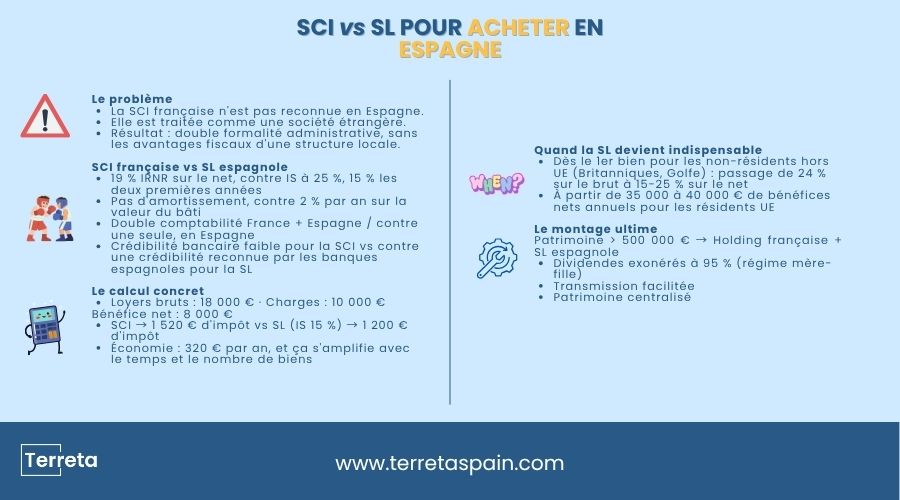
The problem: this tax transparency is not recognized in Spain.
In Spain, a French SCI is treated as a foreign company. It is therefore subject to the IRNR (Nonresident Income Tax).
- 19% of net rental income if the SCI is domiciled in the EU (France, source: https://www.boe.es/buscar/act.php?id=BOE-A-2004-4527)
- With the option to deduct business expenses, but under more restrictive conditions than those for a Spanish SL
- Spanish reporting requirements in addition to French reporting requirements
- Dual administrative system: Spanish accounting + French accounting
On the French side, the partners in the SCI remain subject to taxation on Spanish rental income in accordance with French rules, with the Franco-Spanish tax treaty applied to avoid double taxation.
In practice: The Société Civile Immobilière (SCI) creates administrative and tax complexities in both countries, without offering the tax advantages of a local Spanish entity.
Terra Spain News: The France-Spain tax treaty stipulates that real estate income is taxed in Spain. However, this does not exempt you from filing a tax return in France or from handling administrative matters in both countries. The result: twice as much paperwork, without the benefits.
Do you have questions about your real estate investment in Spain? Schedule a call with our team.
The Spanish SL: The Standard Structure for Real Estate Investment in Spain
The SL (Sociedad Limitada) is the Spanish equivalent of the French SARL. It is the most commonly used structure among foreign investors who purchase real estate in Spain, and for good reason.
Here's what it actually does:
- 25% corporate income tax on net income (15% for the first two profitable fiscal years; source: https://www.boe.es/buscar/act.php?id=BOE-A-2014-12328)
- Deduction of all expenses: loan interest, IBI (property tax), condominium fees, insurance, rental management fees, and property depreciation (2 to 3% per year of the building’s value, according to the AEAT)
- Transfer by assignment of shares, which is simpler and less expensive than a Spanish notarial deed
- Liability limited to the capital contributed
- Greater banking credibility than a purchase made in one's own name or through a foreign entity
Profit on a single property generating €18,000 in gross rent with €10,000 in expenses:
- In one's own name (non-EU resident): 19% × €8,000 = €1,520
- Through a French SCI: similar results, with twice the paperwork
- Through a Spanish limited liability company (IS 15%): 15% × 8,000 € = 1,200 €
The difference is small for a single property, but it increases with the number of properties, the level of expenses, and the length of ownership.
For more information: our comprehensive guide to setting up a Spanish SL.
SCI vs. SL: A Comparative Chart
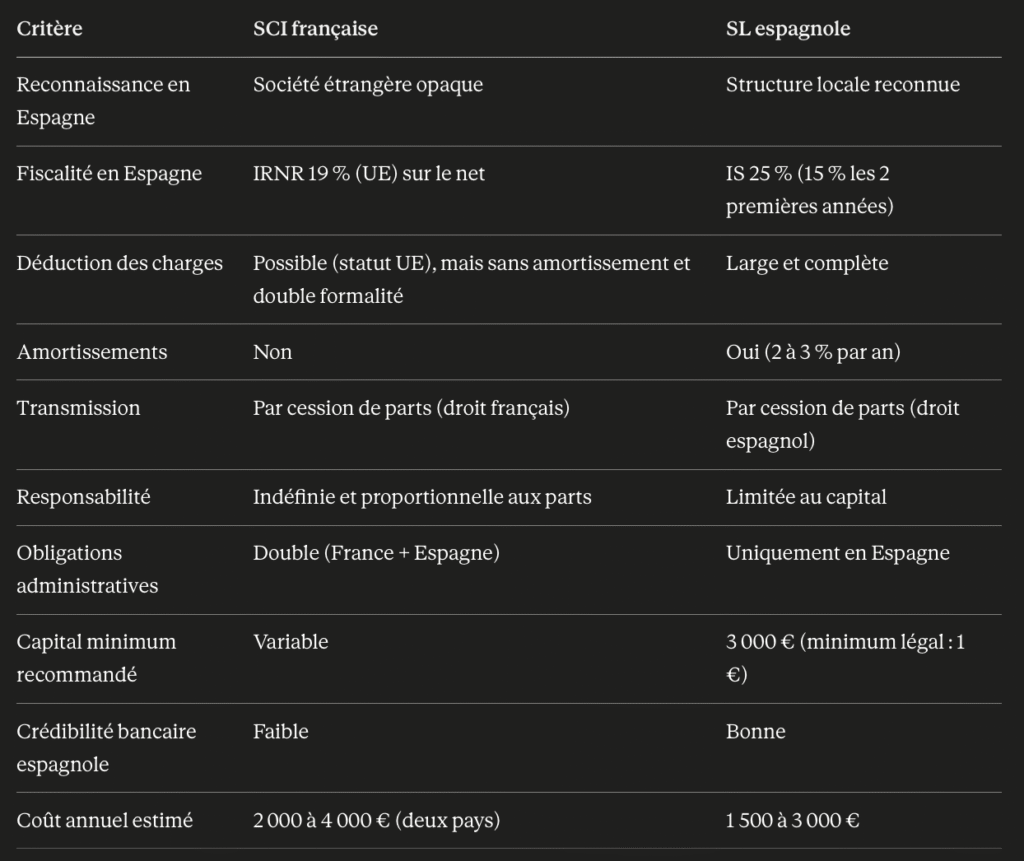
| Criterion | French SCI | Spanish SL |
|---|---|---|
| Recognition in Spain | Opaque foreign company | Recognized local organization |
| Taxation in Spain | 19% IRNR (EU) on net income | IS 25% (15% for the first 2 years) |
| Deduction of expenses | Possible, but without depreciation; requires two steps | Extensive and comprehensive |
| Depreciation | No | Yes (2 to 3% per year) |
| Transmission | Transfer of Shares (French Law) | Transfer of Shares (Spanish Law) |
| Liability | Indefinite and proportional to the shares | Limited to capital |
| Administrative Requirements | Doubles (France + Spain) | Only in Spain |
| Recommended Minimum Capital | Variable | 3,000 € (legal minimum: 1 €) |
| Spanish Banking Credibility | Low | Good |
| Estimated annual cost | €2,000 to €4,000 (two countries) | €1,500 to €3,000 |
When is an SCI still a viable option?
The French real estate investment company (SCI ) remains a viable option in certain specific cases:
- You already own property in France through an SCI and would like to centralize your asset management on the French side. In this case, the SCI can hold shares in a Spanish SL; this is known as a holding company structure.
- Your Spanish real estate project is a second home intended primarily for personal use, with little or no rental income. In this case, taxation is not the main concern, and an SCI may be sufficient for the transfer of ownership.
- You already have partners in an SCIand do not wish to set up a new entity. In that case, weigh the additional administrative costs against the tax benefits of an SL.
To learn more, check out our video on social media:“Buying Through an SCI or SL, or in Your Own Name”
Are you interested in investing in Spain? Contact our team.
The optimal structure for large estates: holding company + Spanish limited liability company
For substantial estates (with Spanish assets totaling €500,000 or more), the most effective structure combines a French holding company (SCI or holding company) that owns a Spanish SL.
The principle:
- The Spanish SL owns the real estate in Spain and generates rental income
- Dividends are remitted to the French holding company under tax-optimized terms thanks to the parent-subsidiary rules (provided the conditions are met)
- The French holding company manages the transfer of assets in accordance with French law
This structure allows you to combine the advantages of a Spanish SL (tax deductions, competitive corporate income tax rate) with those of a French holding company (business succession, overall wealth optimization).
To learn more, read our in-depth report: Holding Company + Spanish S.L.: A Wealth Management Structure for Large Portfolios.
This type of arrangement requires the assistance of a tax specialist in both countries. Terreta Spain coordinates these types of cases with the law firm Delaguía y Luzón in Valencia.
At what threshold does the Spanish SL become attractive?
A Sociedad Limitada incurs fixed costs: administrative services, accounting, filing of financial statements, and annual corporate income tax.
In practice:
- For annual net profits below €35,000 to €40,000: purchasing in one’s own name (for EU residents) is often simpler and just as effective.
- Above this threshold, or if you have many deductible expenses, the SL becomes a clear advantage.
- For non-residents outside the EU (post-Brexit British citizens, Gulf residents): the SL is advantageous starting with the first property, as it allows you to go from 24% on the gross amount to 15–25% on the net amount.
Steps for Setting Up a Spanish SL
- Reserve the company name
- Submit the application online on the Central Commercial Registry website ( page also available in English).
- Suggest up to 5 names for about 15 euros.
- Terreta's Tips: Avoid overly generic names, domain names (.es, .com), adding a city, acronyms/anagrams, combinations of numbers and letters, and phonetic similarities.
- Open a Business Bank Account
- Open a bank account in the company's name and deposit the corporate capital.
- The Ley Crea y Crece law allows for a minimum investment of 1 €, although banks generally do not recommend 1 € due to credibility concerns. We recommend a minimum of 3,000 €.
- Obtain the deposit receipt from the bank for the notary.
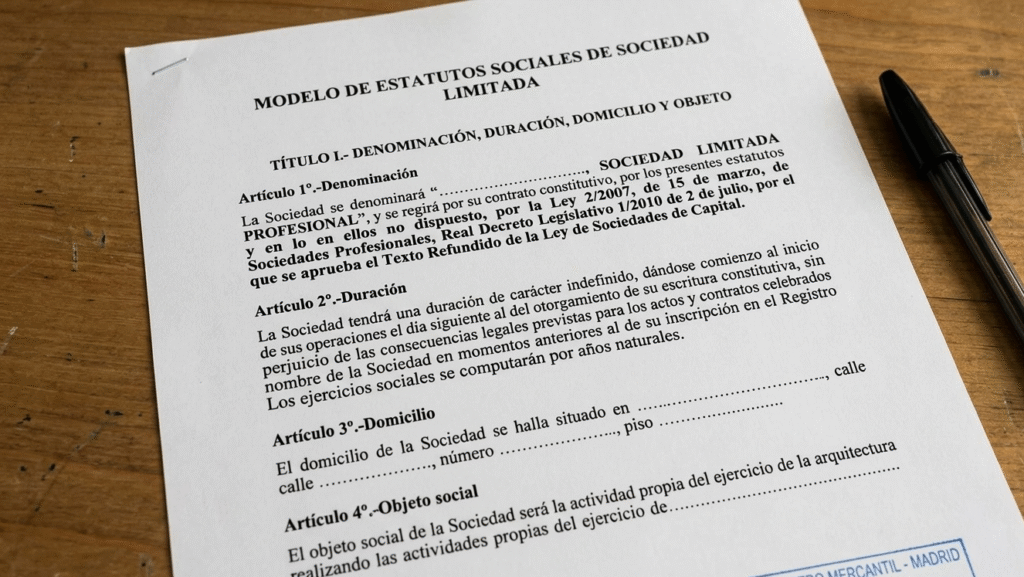
- Draft the articles of incorporation
- Define the company’s operating rules: name + “S.L.”, registered office, corporate purpose, capital stock, distribution of shares, terms governing the transfer of shares and the admission and withdrawal of partners, type of management, compensation for executives, distribution of profits, grounds for dissolution, and liquidation.
- Terra's Tip: Have a professional draft a customized set of articles of incorporation—for example, the multilingual law firm Delaguia Luzón in Valencia—or use a template if you're drafting them yourself.
- Sign the articles of incorporation at the notary's office
- Provide the notary with: articles of incorporation, certificate of corporate name, bank certificate, and the partners’ identification documents.
- The notary verifies the legality and draws up the Deed of Incorporation of the Limited Liability Company (“XXX S.L.”).
- Register with the tax authorities (Agencia Tributaria)
- Registration with the Commercial Registry
- Register the company with the Commercial Registry to grant it full legal status.
- Meet the deadline: no later than 2 months after the articles of incorporation are signed.
- Social Security Enrollment
- Register the manager and any active partners with Social Security through the official portal and using Form TA-6 (available for download at this link).
- Obtaining a Digital Certificate
- Apply for the digital certificate for representatives from the Fábrica Nacional de Moneda y Timbre.
- This certificate is essential for completing all online procedures securely.
In Practice: Deadlines, Costs, and Tips from Terreta
- Typical processing time: between 15 days and 2 months to establish the SL.
- Possible expedited processing: through the PAE (Punto de Atención al Emprendedor) and the Documento Único Electrónico, especially if you already have a digital certificate.
- Share capital: €1 is legally sufficient, but not ideal for banking purposes.
- Estimated total cost: between €400 and €600, up to €900 if you hire a gestor, which Terreta recommends, especially if you’re not comfortable speaking Spanish.
- Useful link: CIRCE (Center for Information and Business Start-up Network) to coordinate and assist with the process.
Tip from Terreta Spain: It is also possible to purchase a pre-incorporated company (sociedad preconstituida)—a company created specifically for transfer, registered with the Registro Mercantil, with a permanent tax identification number (NIF) and fully paid-in capital (typically €3,000).
Advantage: Up and running in 24 to 48 hours instead of 15 to 20 days.
This is the best option if your project is urgent.
Terreta Spain is coordinating this phase with its legal partners, notably the law firm Delaguía y Luzón in Valencia.
Contact:
sonia.gomezluzon@delaguialuzon.com
+34 963 74 16 57
FAQ
Can a French real estate investment company (SCI) purchase property in Spain?
Yes, technically. But it is treated as a foreign company by the Spanish tax authorities, which creates obligations in both countries and prevents it from benefiting from the tax advantages of a Spanish SL.
Is it better to buy through a French SCI or a Spanish SL?
For the vast majority of non-resident investors,the Spanish SL is the most suitable structure for owning property in Spain: local taxation, fully deductible expenses, depreciation, credibility with banks, and administrative obligations all in a single country. A French SCI remains a viable option if you already manage real estate assets in France and wish to centralize their management on the French side, or if your Spanish project is a second home for personal use rather than for rental purposes. In all other cases, and particularly for a rental investment, the SL stands out as the most tax-efficient choice and the simplest to manage on a day-to-day basis.
Can an SCI be converted into a Spanish SL?
Not directly; they are two entities governed by different legal systems. You would need to set up a Spanish SL and transfer the assets, which would incur notary and tax fees. In some cases, it’s better to start with a new entity rather than “convert” the existing one.
Can we buy a pre-established Spanish SL rather than forming one?
Yes. Pre-incorporated companies (sociedades preconstituidas) are available for sale, with a permanent tax identification number (NIF) and fully paid-in capital. The transfer is formalized at a notary’s office, and the company is operational within 24 to 48 hours. This is an option to consider if your project is urgent. Caution: Always conduct due diligence to verify the absence of debts or hidden liabilities before signing.
Can my Spanish SL own my primary residence?
Technically, yes, but it’s generally not recommended. A primary residence used for personal purposes does not generate rental income, which reduces the tax benefits of the SL. This should be analyzed on a case-by-case basis.
Do I need to keep Spanish accounting records for an SL?
Yes, it is mandatory. The SL must file its annual financial statements and report its corporate income tax using Form 200. A local accounting firm can handle these obligations for €1,000 to €2,000 per year, depending on the size of the company.
Can a group of people make a purchase through a Spanish limited liability company (SL)?
Yes, that’s actually one of the advantages of this structure. Shares are distributed among the partners based on each partner’s capital contribution. A partners’ agreement governs the company’s governance and exit provisions.
Do I need to register my Spanish SL in my country of residence?
In most cases, yes—particularly in France (foreign income must be reported on Form 2047 and noted on Form 2042 if dividends are remitted).
You must check with your local tax advisor based on your country of residence.
For more information:
- Should I invest as an individual, through an SL, or through a SOCIMI?
- Set Up a Spanish SL for Your Real Estate Investments
- Tax Residents in the United Kingdom: How to Optimize Your Purchase in Spain
- The steps involved in buying property in Spain
- The Beckham Diet in Spain
- Corporate Income Tax in Spain
- Holding Company + Spanish S.L.: A Wealth Management Structure for Large Portfolios.
This article is intended for general informational purposes only and does not constitute personalized tax or legal advice. Each situation should be reviewed with a Spanish tax attorney and a tax advisor in your country of residence. The tax rates and rules mentioned are those in effect as of June 2026 and are subject to change.