Updated in July 2026
Buying a property at a discount, renovating it, and reselling it for a profit: real estate flipping is a dream come true, and the Spanish market has long been a particularly lucrative playground for this strategy. Except that in 2026, the landscape has changed—and not in the way many investors still imagine. With soaring purchase prices, rising renovation costs, and taxes eating into a significant portion of the profit margin,flipping remains profitable—but only for those who know where and how to do it.
Key Takeaways
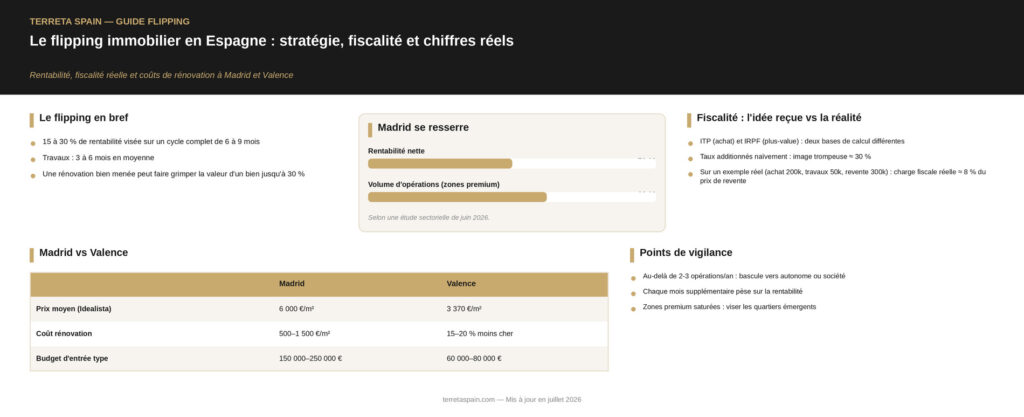
In summary: At Terreta Spain, a well-executed flipping project typically aims for a return of 15 to 30% over a full cycle of 6 to 9 months, including purchase and resale, with the renovation work itself taking 3 to 6 months. Part of this margin is due to the renovation itself, which can increase a property’s value by up to 30% in certain areas, according to our construction director, Gaetano Grana.
But this profitability has narrowed significantly in Madrid, where steadily rising purchase prices leave less and less room to absorb renovation costs: the net profitability of flipping there has fallen by 50 percent, according to a June 2026 industry study. On the tax front, ITP and IRPF are not calculated on the same basis: once the calculation is done correctly, the actual tax burden of a transaction is around 8% of the resale price—far from an aggregate rate that would paint a misleading picture.
In this increasingly challenging environment, managing the cost and quality of a renovation project has become the key factor that distinguishes a profitable project from one that is not. And that is where Terreta Spain is clearly the right partner.
Key Takeaways
- At Terreta Spain, a well-executed flipping project aims for a 15 to 30 percent return over a full cycle of 6 to 9 months, including renovation work (3 to 6 months)
- A well-executed renovation can increase a property's value by up to 30% in certain areas, according to Gaetano Grana, our construction manager
- In Madrid, net profitability from property flipping has fallen by 50 percent, according to a June 2026 industry study, and transaction volumes have dropped by 62 percent in certain premium areas
- The effective tax rate on a transaction is approximately 8% of the resale price, once the ITP and IRPF have been correctly calculated based on their respective tax bases.
- Typical starting budget in a major city: €150,000 to €250,000, all-inclusive (purchase price, renovations, taxes)
- The quality and cost control of a renovation have become the decisive factor in profitability, more so than simply timing the market
Real Estate Flipping, Explained: Definition and Actual Profitability
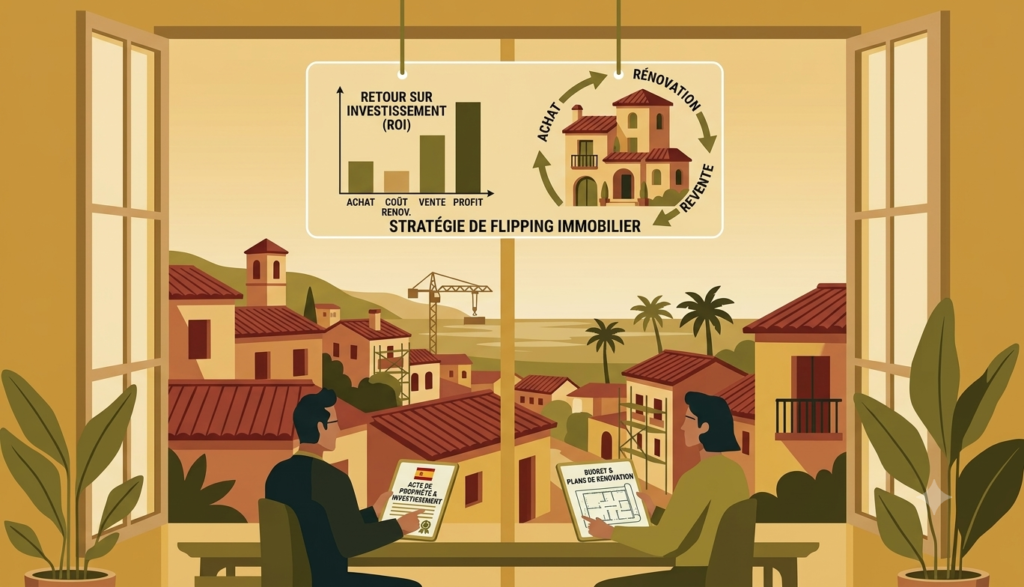
The term comes from the English verb “to flip,” meaning “to turn over.” When applied to real estate, it refers to a three-step process:
- Buying a property for less than its true value.
- Carry out a renovation that increases the property's value.
- Resell it quickly at a profit.
Note: Unlike rental investing, which aims to generate long-term passive income, property flipping seeks quick liquidity and profitability concentrated over a few months.
On paper, the numbers are staggering. At Terreta Spain, a well-executed property flip typically aims for a return of 15 to 30 percent over a full cycle of 6 to 9 months, including purchase and resale. The renovation work itself takes an average of 3 to 6 months. Part of this margin is directly attributable to the renovation itself: according to Gaetano Grana, our construction director, a well-executed renovation can increase a property’s value by up to 30% in certain areas. By comparison, traditional residential rentals are projected to cap out at 6% gross in 2026 (Fotocasa), and even drop to around 4.5% net once taxes and expenses are deducted.
But be careful not to confuse theoretical profitability with the reality on the ground in 2026, especially in large cities.
Thinking about a real estate project in Spain?
The Terreta Spain team supports you every step of the way: sourcing, negotiation, due diligence, and connecting you with our partner attorneys and tax advisors.
Contact Terreta SpainMadrid: The Real Estate Market Is Tightening
This is the most important point to keep in mind before getting started. In Madrid, traditional flipping (buying older properties, renovating them, and reselling them at a premium) is showing clear signs of slowing down. According to a June 2026 industry study, the net profitability of this type of transaction fell by 50% over the most recent period analyzed, and the volume of renovation-resale transactions declined by more than 62% in certain premium areas.
The reason is straightforward. Prices for existing homes rose by 13.5% year-over-year in the first quarter of 2026 (INE); add to that the cost of renovation, which is also on the rise. As a result, the numbers no longer add up as easily in central, sought-after, and expensive neighborhoods.
This tightening of the market doesn’t mean that property flipping in Madrid is dead; it means that there’s no longer any room for error and that you have to turn to up-and-coming neighborhoods (Puente de Vallecas, Usera, Villaverde, Carabanchel, Ciudad Lineal, etc.) to be successful. One wrong location, one miscalculation of renovation costs, or a prolonged sales period—and the deal goes into the red. It is precisely in this context that renovation support makes all the difference. Terreta’s support, of course.
Taxation of Property Flipping in Spain
A property flipping transaction gives rise to tax obligations at two distinct points in time, based on two different calculation bases that should not be confused: the property transfer tax (ITP) is calculated based on the purchase price, while the personal income tax (IRPF) is calculated based on the capital gain realized upon resale—they are not based on the same tax base.
- When purchasing an older property, the Impuesto sobre Transmisiones Patrimoniales (ITP) applies, with a rate ranging from 6% to 10% depending on the autonomous community, plus notary and registry fees.
- Upon resale, only the realized profit is subject to personal income tax (IRPF), calculated as part of the savings base, according to a progressive tax rate ranging from 19% to 26%. In addition, there is the municipal capital gains tax—a local tax on the appreciation in land value—which must be paid to the city hall.
Real-world example: A property purchased for €200,000 in Madrid (with an 8% ITP in certain areas, or €16,000), renovated for €50,000, and then resold for €300,000. The capital gain subject to personal income tax (IRPF) in this case amounts to €34,000 (resale price minus the total cost of acquisition and renovation), which translates to approximately €7,000 in personal income tax based on the progressive tax scale. When adding an estimated municipal capital gains tax of €2,000, the total tax burden for the transaction is approximately €25,000—about 8% of the resale price—which is far from an aggregate rate that would give a misleading picture by simply adding the property transfer tax (ITP) and personal income tax (IRPF) rates as if they applied to the same tax base.
Another point to keep in mind: if you conduct more than two or three transactions per year, the Spanish tax authorities may consider the activity to be professional in nature and require you to register as a self-employed individual or form a company. You should discuss this structure with a tax advisor before carrying out your first transaction.
Income Tax Rates on Capital Gains from Resale
Applicable to the net gain realized on the sale
In addition, there is the municipal capital gains tax (a local tax on increases in land value), which must be paid to the relevant city hall. In the example detailed above, the total tax burden amounts to approximately 8% of the resale price.
For a complete breakdown of these fees:
- Our article on the costs of buying real estate in Spain;
- And our guide to ITP in Spain goes into more detail on a region-by-region basis.
Real Estate in Spain: When Does Renovating Really Make a Difference?
In a market where profit margins have narrowed—particularly in Madrid—investors still have control over two key factors: the purchase price and the cost of renovation. The former depends largely on the ability to identify the right opportunities, which are often found outside traditional real estate portals. The latter depends directly on the quality of support provided during the renovation process. These are two areas in which Terreta Spain has built its expertise.
More than 120 projects have been completed since 2022, primarily in Madrid and Valencia, based on a simple principle: anticipating added value. Knowing which improvements truly appeal to buyers when the property is resold, which renovations optimize energy efficiency (a factor increasingly valued by buyers), and, above all, which mistakes to avoid so that your profit margin doesn’t shrink during construction.
Details about our method and advice from our construction manager, Gaetano Grana, can be found in our article on renovations in Spain and in his interview.
In Madrid, renovation costs range from €500 to €1,500 per square meter, depending on the level of finish. In Valencia, renovation costs are generally 15 to 20 percent lower than in Madrid, a gap that narrows for entry-level renovations and is most noticeable for high-end finishes (up to €1,250 per square meter).
Our advice: The choice of finish level should be based on the profile of the target buyer for resale, not on a passing whim.
Valencia: An Alternative to Watch
While the Madrid market is tightening, Valencia remains a significantly more affordable place to buy, with an average price still well below that of the capital: €3,370 per square meter versus €6,000 per square meter (Idealista). It is also a market where older properties—often with strong potential for appreciation through renovation—remain plentiful, particularly in historic neighborhoods such as Ruzafa and La Xerea.
To explore Valencia’s neighborhoods with high growth potential, check out our guide to the most profitable neighborhoods and districts in Valencia.
FAQ
Is real estate flipping legal in Spain?
Yes, absolutely. Buying, renovating, and reselling real estate is a lawful economic activity. However, if you conduct more than two or three such transactions per year, the tax authorities may consider the activity to be professional in nature and require you to register as a self-employed individual or a business.
How much should you budget for your first property flipping project?
In large cities like Madrid, expect to spend between €150,000 and €250,000 all-inclusive (purchase price, renovations, taxes). In medium-sized cities or more affordable areas, an initial investment can start at around €60,000 to €80,000.
Will property flipping still be profitable in Madrid in 2026?
Yields have narrowed significantly in historically strong premium neighborhoods, with net yields down 50 percent, according to a June 2026 industry study. It’s still possible, but it requires much more precise control over the purchase price and renovation costs than it did a few years ago.
How long does a typical property flipping transaction take?
Typically between 6 and 9 months from purchase to resale. Each additional month reduces profitability (condominium fees, property tax, opportunity cost of tied-up capital), which is why it’s important to have an effective sales plan in place as soon as construction is complete.
Conclusion
Flipping is our playground
Sourcing, accurate renovation cost estimates, construction site management, and referrals to partner tax advisors: the Terreta Spain team supports investors at every stage of a flipping project, in both Madrid and Valencia. Our strength: more than 120 projects completed since 2022, all driven by a shared focus on maximizing capital gains before the first hammer even hits the wall.
For more information:
→ Renovating in Spain with Terreta Spain
→ The Steps Involved in Buying Real Estate in Spain
→ Luxury Real Estate in Madrid
→ The Complete Guide to the ITP in Spain
→ Understanding the IRNR for Non-Residents
Thinking about a real estate project in Spain?
The Terreta Spain team supports you every step of the way: sourcing, negotiation, due diligence, and connecting you with our partner attorneys and tax advisors.
Contact Terreta SpainFor more information, check out our articles:
- The steps involved in buying property in Spain
- Investing in Spain: What Kind of Support Should You Choose, and Why It Makes All the Difference
- Property Finder In Spain, how do you choose the right one?
- Everything You Need to Know About Property Renovation in Spain
- Interview with Gaetano Grana, Construction Manager at Terreta Spain