Updated in June 2026
Form 720 is a bit like that tax form everyone has heard of , that no one really understands, and that many people forget about until March. Yet it is one of the most important tax obligations for expatriates living in Spain who still have assets in their country of origin.
Good news: this is purely an informational filing. But forgetting to file it or doing a sloppy job can have serious consequences, especially when you want to sell a property in Spain.
This Terreta Spain guide explains in practical terms who is required to file Form 720, what to report, how to fill out the form step by step, and what has actually changed since 2022—because, let’s face it, no need to stress, but… things change often.
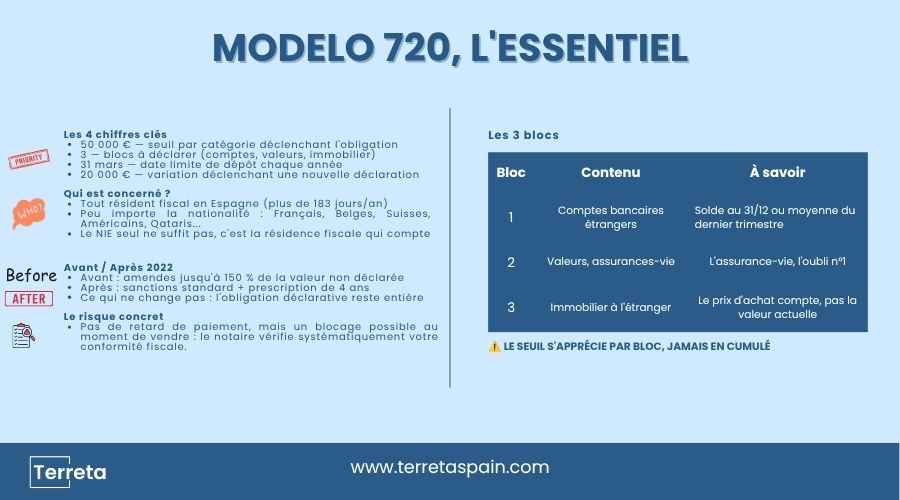
Key Figures
-category threshold triggering the obligation
(accounts, securities, real estate)
's annual application deadline
a new declaration
What exactly is the Modelo 720?
Form 720 is the informational return that all tax residents in Spain must file regarding their assets and rights held abroad. In other words: if you live in Valencia or Madrid but still own an apartment in Lyon, have an account with Société Générale, or hold a life insurance policy with AXA, this applies to you.
The goal? To give the Spanish tax authorities insight into what you own outside the country. Not to tax you more, but to prevent tax evasion.
What the 720 model is not:
- A tax: You don't pay anything just by filling it out
- Optional: Once the thresholds are exceeded, it is a legal requirement
- A Matter of Nationality: What Matters Is Being a Tax Resident of Spain and Owning Property Abroad, Regardless of Your Passport
Who is required to file it?
Any individual or legal entity that is a tax resident of Spain and owns assets abroad that exceed the thresholds. Okay, it sounds simple on paper, but there are a few nuances to be aware of.
The prerequisite: being a Spanish tax resident.
- Do you spend more than 183 days a year in Spain?
- You area Spanish tax resident
- The Modelo 720 applies to you if your foreign assets exceed the thresholds
- And this applies to everyone: French, Belgian, and Swiss citizens, as well as Americans, Qataris, Canadians, and people of any other nationality, as long as they are established as Spanish tax residents
Note: Having an NIE is not enough to qualify as a Spanish tax resident. You can have an NIE (to buy property, for example) without ever becoming a tax resident. It is only your actual situation—the 183-day rule—that triggers the obligation.
And keep in mind, this doesn’t apply only to direct owners. The account holder must file a return, of course, but so must anyone with power of attorney, a mandate, or authorization regarding the account. When it comes to real estate, bare owners and co-owners are in the same boat.
The Three Categories to Be Reported and Their Thresholds
Modelo 720 is organized into three distinct categories: foreign bank accounts, securities and insurance policies managed outside of Spain, and real estate located abroad.
The trigger threshold is €50,000 per block, and that really means per block—not “in total.” Never by adding the blocks together. This is the point that is most often misunderstood.
The €50,000 threshold is assessed by category—never by adding the categories together. This is the point that is most often misunderstood.
Section 1: Foreign Bank Accounts
Checking accounts, savings accounts, and time deposits held at a bank outside of Spain. We look at two figures: the balance as of December 31 AND the average balance for the last quarter. The higher of the two determines whether or not the requirement applies.
Examples: Crédit Agricole, Société Générale, BNP, and N26 accounts with French IBANs; UBS in Switzerland; and HSBC in London.
Module 2: Values, Rights, Insurance, and Income
Stocks, bonds, investment funds (PEA, standard securities account), and—be careful, because this is where many people are caught off guard—life insurance policies purchased from a foreign insurer. The surrender value as of December 31 is the reference point.
👉 French life insurance is the asset most often overlooked by expatriates. As soon as the cash value exceeds €50,000, it falls under Block 2 and must be reported.
Section 3: Real Estate Located Outside Spain
This applies to most French, Belgian, and Swiss nationals living in Spain. You add up the purchase prices of all your foreign real estate. Two apartments purchased for €30,000 and €35,000, respectively = €65,000: you exceed the threshold, so you must report both.
When it comes to real estate, it’s the historical purchase price that counts, not the current market value. An apartment bought for €120,000 that’s worth €200,000 today is reported as €120,000—and one is tempted to say…thank goodness!
Terreta’s tip: For any asset denominated in a foreign currency, use the official exchange rate published by the Bank of Spain as of December 31 of the relevant year. Not Google, not Claude, not your bank—the official rate, period.
The BDE's official exchange rates can be found here: https://www.bde.es/webbe/es/estadisticas/compartido/datos/pdf/tc_1_1.pdf
A helpful note: Cryptocurrencies held on foreign platforms are not reported on Form 720. Since 2023, they have their own form: Form 721.
Do you have questions about Form 720 or real estate in Spain? Contact the Terreta Spain team
When should you file Form 720?
Between January 1 and March 31 of the year following the relevant fiscal year. For assets as of December 31, 2025: the deadline is March 31, 2026. In the event of a technical issue on the AEAT platform, a grace period of 4 calendar days applies.
And the following year, do I have to do it all over again? Not necessarily. Once you’ve filed your first return, you’re only required to file again if the value of a block increases by more than €20,000 compared to your last return, or if you’ve sold or acquired an asset in a block that hasn’t yet been reported. In all other cases, you don’t need to file Form 720.
How to Fill Out Form 720: A Step-by-Step Guide
Step 1: Log in to the AEAT’s Online Portal
The declaration must be filed exclusively online at sede.agenciatributaria.gob.es. There is no paper version, and nothing can be sent by mail; everything is done through the portal.
Site path: Home > All Services > Taxes and Fees > Informational Returns > Form 720

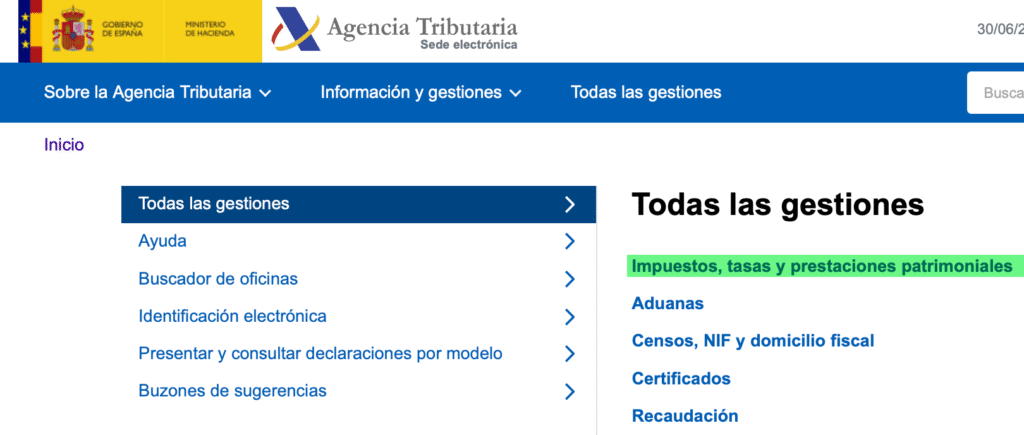
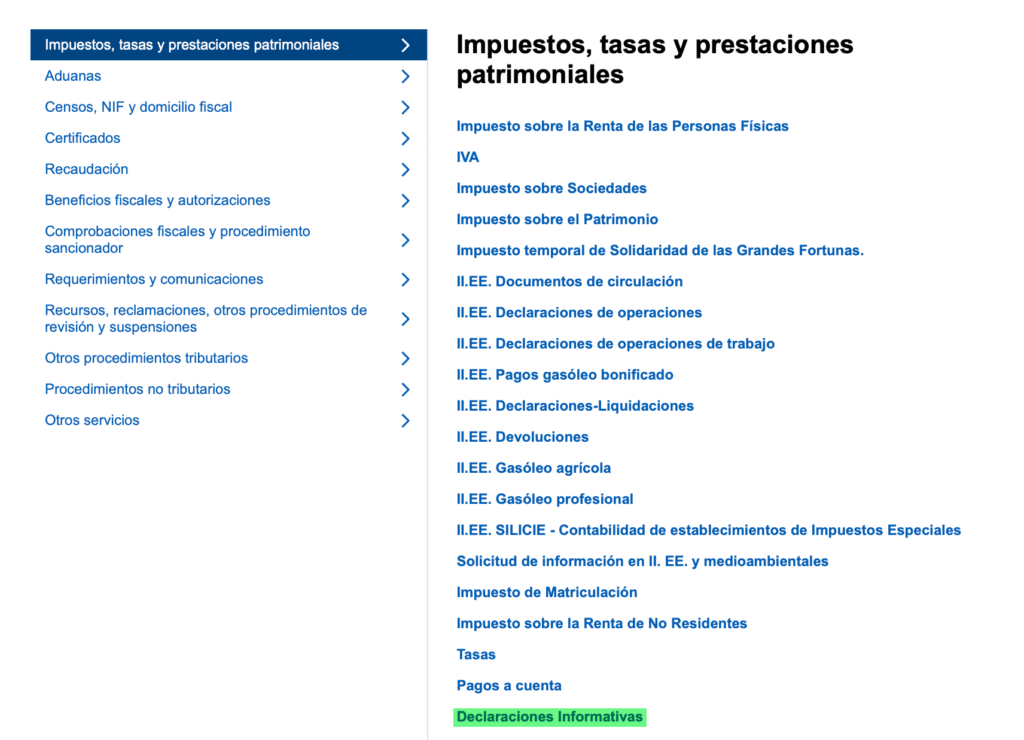
To log in, you have three options:
- Digital Certificate: a file installed on your computer, the standard for tax-related procedures
- Cl@ve PIN: a temporary code sent to your phone—more convenient if you're using a mobile device
- Electronic DNI: For Spanish Citizens
Step 2: Enter your personal information
Once you've logged in, a page will ask for your NIF (Tax Identification Number) or your NIE (Foreigners' Identification Number) if you're a foreigner, as well as your last name, first name, and contact information.
Please note: Use exactly the same information as that on file with the Agencia Tributaria—no spelling variations, no abbreviations.
Next, click “Continuar.” You can also import a pre-filled form or resume a saved session if you weren’t able to finish the last time.
Step 3: Create a ledger for each asset or account
This is the main part of the form. Click “Nuevo Registro” for each asset you need to report.
One account, one asset, one life insurance policy = one separate record. Each record is divided into four sections.
Section A: Reporter Information
The “declarant’s condition key” field defines your relationship to the property:
- 1 = sole owner
- 2 = representative or agent
- 3 = beneficiary
- 4 = authorized person
- 5 = actual owner (beneficial owner)
In the vast majority of cases, you will check 1.
Section B: Type of Property or Right
The “key: type of property or right” field (position 102) determines which block you use to report:
- C = Foreign Bank Account (Block 1)
- V = Securities, Stocks, Funds (Block 2)
- S = Insurance and Pensions (Block 2)
- I = Real Estate (Block 3)
For bank accounts, the subkey (position 103) specifies the type:
- 1 = checking account
- 2 = savings account
- 3 = time deposit
- 4 = credit account
Section C: Entity’s Domicile or Location of the Property
For a financial account or asset: the full address of the foreign bank (street, city, ZIP code, two-letter ISO country code: FR for France, CH for Switzerland, GB for the United Kingdom, BE for Belgium).
For real estate: the exact address of the property abroad.
Section D: Information on the Property or Right
That's where the key figures come into play:
| Field | What to Include |
|---|---|
| The Origin of Good (entry 423) |
A = first declaration / B = already declared / C = termination of tenure |
| Date of inclusion (pos. 415–422) |
Date the account was opened or the property was acquired (format YYYYMMDD) |
| Review 1 (pp. 432–446) |
Balance as of December 31 for accounts / purchase prices for real estate |
| Review 2 (items 447–461) |
Average balance for the last quarter (accounts only) |
's share(pos. 476–480) |
100 if you are the sole owner / 50 if the property is jointly owned in equal shares. For jointly owned property with unequal shares, indicate your actual percentage of ownership (e.g., 30 if you own 30% of the property) |
For joint ownership with unequal shares, indicate your actual percentage of ownership (e.g., 30 if you own 30% of the property).
Step 4: Review before sending
Once you have entered all your assets, click “Validate.” The system will flag any critical errors and warnings. Correct the errors before proceeding. Some non-critical warnings can be ignored if they do not apply to your situation.
Next, click on “View Filing” to see an overview of everything you’ve reported. Take the time to double-check: a valuation error or a misclassified asset can lead to complications.
Step 5: Sign and Send
Click “Sign and Submit.” The portal generates an official PDF of your validated declaration.
Download it and keep it in a safe place: it’s your proof of filing, and the notary will ask you for it if you sell a property in Spain.
6. Real-world examples for French-speaking profiles
Case 1: A French citizen living in Valencia who owns an apartment in Lyon
- Apartment purchased for €180,000; current market value €230,000.
- BNP France account: €22,000. → Threshold 3 triggered (€180,000 > €50,000).
- Report the apartment with Valoración 1 = €180,000, country code FR, and the exact address of the property.
- → Bloc 1 non déclenché (22 000 € < 50 000 €). Le compte BNP ne se déclare pas cette année.
Case 2: A Belgian resident in Madrid with a life insurance policy from AG Insurance (Belgium) worth €65,000
- → Block 2 triggered.
- Report the contract with the surrender value as of December 31 as Valuation 1, type S, country code BE.
- No other foreign assets? This is the only record you need to create.
Case 3: Switzerland is a 50% co-owner of a chalet in Haute-Savoie purchased for €320,000
- His share: €160,000. → Block 3 triggered.
- Valuation 1 = €160,000, ownership percentage = 50.
Case 4: A French national living in Barcelona with a €45,000 PEA account at Fortuneo and a €12,000 account at Boursorama
- → No block exceeds €50,000.
- Nothing to report this year.
- If your PEA exceeds €50,001 as of December 31 of a strong stock market year, the requirement takes effect as of that fiscal year. It is the value on that specific date that counts, not a one-time peak during the year. Be sure to check this at the end of every December.
7. What Has Changed Since 2022: Sanctions
For years, Modelo 720 had a terrible reputation—and for good reason. Penalties for failure to report could reach 150 percent of the value of the unreported assets, plus fixed fines, all with no statute of limitations. It was a real administrative nightmare.
On January 27, 2022, the Court of Justice of the European Union (Judgment C-788/19) put an end to this system, ruling that it was contrary to the principle of the free movement of capital and to the fundamental rights of taxpayers.
code html phrase en exergue : <p><strong>Le Modelo 720 n’a pas disparu après 2022 : l’obligation reste entière. Ce qui a changé, c’est la fin des amendes disproportionnées — pas la fin de la déclaration.</strong></p>
Since the reform (Law 5/2022), the standard penalties under the General Tax Law apply, with a 4-year statute of limitations. The main risk in the event of an omission: The tax authorities may reclassify undeclared assets as an unjustified capital gain, with late payment interest added. This gain is taxed as ordinary income for the earliest tax year not subject to the statute of limitations, which can cause the tax bill to rise well beyond the simple value of the omitted asset.
Are you interested in investing in Spain? Contact the experts at Terreta Spain.
The Most Common Mistakes
- Confusing market value with purchase price. For Block 3, you report what you paid at the time, not what it’s worth today.
- Forget about French life insurance. This is the number one oversight among French-speaking expatriates. As soon as the cash value exceeds €50,000, it falls under Block 2.
- Do not resubmit after a sale. Have you sold a property that was previously reported? You must file a new declaration to report the termination of ownership: enter code C in the “Origen del bien” field.
- Using the wrong exchange rate. The Bank of Spain’s official exchange rate as of December 31 of the fiscal year in question.
- Neglecting a jointly owned property. Even 20% of a property worth €400,000 amounts to €80,000, which is above the threshold. It’s your share that counts, not the total value of the property.
Don't wait for Hacienda to follow up with you. It won't. It's up to you to file your taxes, and the last four years are still subject to audit. The notary, on the other hand, will be much less lenient.
Conclusion
The Modelo 720: A simple obligation to manage if you plan ahead
Form 720 is feared for no good reason. It is an informational return—you don’t pay anything by filing it. In most cases, you don’t have to refile it every year. And since 2022, the disproportionate penalties that made it so daunting have been eliminated.
What remains: a legal requirement, with a deadline of March 31, for any person who is a tax resident in Spain and holds more than €50,000 in one of the three categories of foreign assets.
The right approach: Identify your foreign assets in January, check the thresholds by category, and file by March 31. With a good tax advisor, it only takes an hour.
Talk to an expert at Terreta SpainFrequently Asked Questions
Does Modelo 720 apply to nonresidents who own property in Spain?
No. Form 720 applies only to tax residents of Spain for their property located abroad. If you live in France and own property in Spain, Form 210 (IRNR) applies to you, not Form 720.
Do I have to file Form 720 every year?
No, not automatically. You only need to file another Form 720 if the value of a block increases by more than €20,000 compared to your last filing, or if you have sold or acquired an asset in a block that has not yet been reported. In all other cases, you do not need to file Form 720.
Does the Modelo 720 apply to my French life insurance policy?
Yes, if you are a tax resident in Spain. Life insurance policies purchased from a foreign insurer are included in Block 2 as soon as their cash value as of December 31 exceeds €50,000. This is one of the most commonly overlooked assets—and one of the most common among French-speaking expatriates.
What value should be reported for real estate held in joint ownership?
Your share of the total purchase price. If you own 50% of an apartment purchased for €300,000, you report €150,000 under “Valuation 1” and enter 50 in the “percentage of ownership” field. It is your share that counts, not the total value of the property.
Does Form 720 result in a tax liability?
No. This is purely an informational declaration. By filing it, you do not have to pay anything to the Agencia Tributaria. It is a transparency requirement, not an additional tax on your foreign assets.
What are the consequences of failing to file or filing late after 2022?
Disproportionate fines were eliminated by the 2022 reform. However, the standard penalties under the Ley General Tributaria still apply, and the tax authority (Hacienda) may reclassify undeclared assets as unjustified capital gains, with late-payment interest. The statute of limitations is 4 years. In practical terms, the most tangible risk remains the blocking of a sale: the notary systematically verifies tax compliance before signing.
Can I fill out Form 720 myself, or do I need a professional?
Technically, yes, the AEAT platform is accessible to any taxpayer with a Certificado Digital or a Cl@ve PIN. In practice, however, for a first-time filing or if you have multiple assets in different countries and currencies, a Spanish tax advisor is strongly recommended. The cost is modest—often between €100 and €300—and it protects your tax return from classification or valuation errors, which are much more expensive to correct later on.
For more information:
- IRNR: Nonresident Income Tax
- The steps involved in buying property in Spain
- Tax Filing in France for Your Properties in Spain
- The Complete Guide to Taxes on Real Estate Purchases in Spain