Square meters in Spain: why does your 120 m² apartment seem to be... 95 m²?
If you are French, Belgian, Swiss, Italian, German, or a foreigner from any other country, and you are looking to buy real estate in Spain, you have probably experienced this scenario:
You visit an apartment advertised as 120 m².
You walk in, look around... and think to yourself:
"Wait... where's the rest of the apartment?"
Rest assured: this is generally neither a scam nor a problem with your eyesight.
The reality is much simpler: square meters are not calculated in the same way in Spain as they are in France, Belgium, Italy, Switzerland, Germany, or any other country.
In this article, we explain:
-
the difference between built square meters and usable square meters in Spain
-
the closest equivalent to the living area, or the Carrez area in France.
-
and why a 120 m² property in Spain can sometimes only offer 95 m² of living space.
In many countries: the reference is the living area.
In almost every country, real estate areas are calculated differently compared to neighboring countries.
In some countries, the actual living area is calculated, i.e.:
✔ only areas where the ceiling height exceeds a certain height
✔ excluding walls and partitions
✔ excluding staircases, ducts, or doorways
✔ excluding balconies, terraces, basements, or garages
In summary:
👉 We measure the space in which you can actually live.
This is why the "usable" or "livable" area generally corresponds fairly well to the actual impression given by the property. This is not the case with the "built" area, which is the area used by Spaniards to communicate (real estate ads, advertised square footage, etc.).
In Spain: the most commonly used term is“superficie construida” (built area).
In Spain, most real estate ads indicate another measurement: the “superficie construida” (built area).
And that's when things get... interesting.
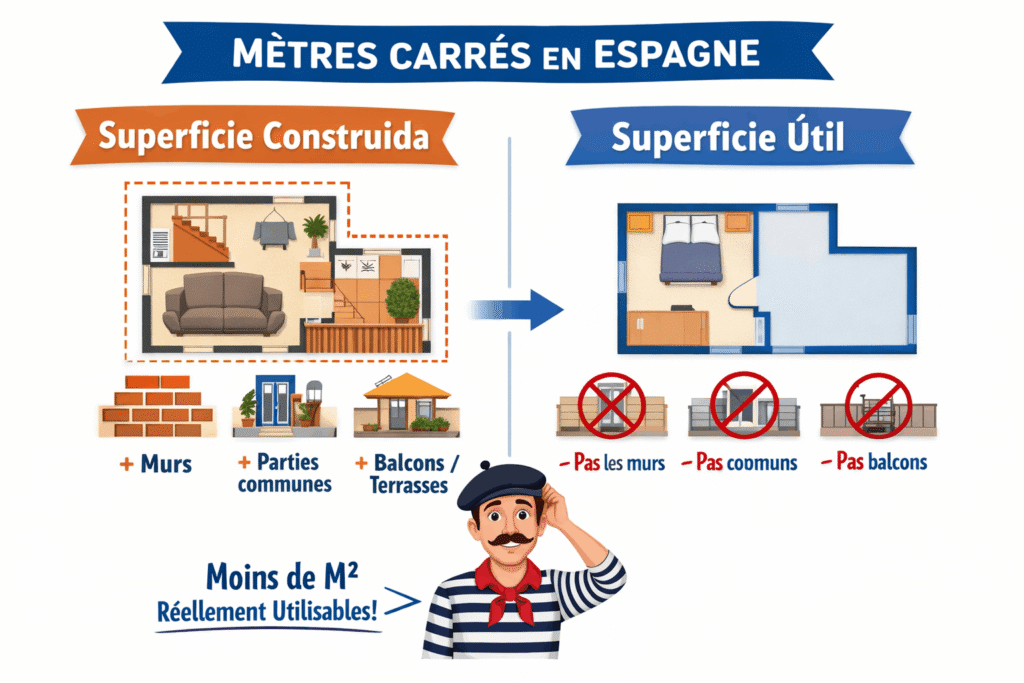
The "builtarea"includes:
✔ the interior surface area of the dwelling
✔ the thickness of the walls and partitions
✔ part of the exterior walls
✔ the pro rata share of the common areas of the building (corridors, staircases, hallways, etc.)
✔ sometimes terraces or balconies
In other words:
In Spain, we don't just measure your apartment...
we measure a small part of the building with it.
Result: the advertised floor space is often 10 to 20% higher than the actual living space.
Usable area: the closest equivalent to living space
In Spain, there is also another measure:
the "superficie útil" (usable area).
This area corresponds more closely to what we often refer to as "living space."
The "usable area" includes:
✔ Actual usable interior space
✔ Excluding walls
✔ Excluding common areas
And with a minimum height:
👉 The minimum height is 1.50 m.
Terraces, balconies, and porches are not included in the usable area.
In most cases, the Spanish "usable area" is very close to the "living area," as it is called in many countries.
Concrete example
Let's take a look at an apartment advertised in Spain:
Built area: 120 m²
In these 120 m², you can have:
-
95 m² of actual interior space
-
10 m² of walls and partitions
-
10 m² share of common areas
-
5 m² of balcony or terrace included
👉 Result:
Actual usable area: approximately 95 m²
This is why some buyers feel that Spanish apartments "shrink" during viewings.
Beware of "false square footage"
And now, let's talk about an even more important topic:
undeclared square meters.
In Spain, it is relatively common for certain jobs to be carried out without being officially registered.
For example:
-
conversion of a garage into a bedroom
-
closing off a patio to create a room
-
attic conversion
-
construction of an outbuilding
The problem:
These areas do not appear in the land registry or property records.
Officially, they do not exist.
But in real estate ads... they sometimes appear anyway.
Why this is a problem for the buyer
These undeclared square meters can create several complications:
1️⃣ For your financing
Banks base their estimates on official surface areas.
If a property is sold as 200 m² but only 150 m² are declared, the bank will calculate the value based on 150 m².
Your loan may therefore be much lower than expected.
2️⃣ For resale
At the time of sale, only the official surface areas may appear in the deed.
The others cannot be mentioned.
3️⃣ For legality
In some cases, the city hall may request:
-
regularization of works
-
or even their demolition
Fortunately, in some regions, offenses can become time-barred after several years.
In the Valencian Community, for example, the statute of limitations can be up to 15 years.
Where can you verify the actual surface area of a property?
To find out the official surface areas, please consult:
1️⃣ The simple note (property registry)
PLEASE NOTE: The square footage listed in the property description is not a reliable reference. It may be significantly inaccurate or even completely incorrect. The primary purpose of this document is to identify the property owner, specify the date of purchase, and indicate any encumbrances or debts associated with the property.
The abstract typically states:
-
usable area
-
built-up area
However, as we noted above, the area listed in the simple note is not a reliable reference.
2️⃣ The land registry
The land registry mainly refers to the cadastral built area, which is used in particular to calculate the IBI (the equivalent of property tax).
There may sometimes be differences between the cadastre and the registry.
And yes... even government agencies are not always perfectly synchronized.
The simple rule to remember: 20% less
When viewing a property in Spain:
👉 Built area = marketing area
👉 Usable area = actual area
And on average:
The usable area is often 10 to 20% smaller than the built area.
The Terreta Spain Council
When analyzing a property in Spain, never rely solely on the figures in the advertisement.
Always ask:
-
usable area
-
the nota simple (to be used solely to verify the identity of the property owner; the area indicated therein is not reliable — see above for more details)
-
cadastral information
This will enable you to know the actual living space and avoid unpleasant surprises.
At Terreta Spain, we systematically analyze these factors before each purchase so that our clients know exactly what they are buying and how many square meters they will actually have at their disposal.
Because in real estate, square footage doesn't disappear...
but it can sometimes be hidden in the walls, staircases, or hallways of the building.
If you want to buy property in Spain and avoid these kinds of pitfalls, our team can assist you every step of the way.
For more information, check out our article on the main pitfalls to avoid when buying property in Spain.
FAQ – Frequently Asked Questions
The "usable area" best corresponds to the actual living space.
Because advertisements often indicate the constructed area, which includes walls and common areas.
The constructed area includes walls and sometimes common areas, while the usable area corresponds to the area that can actually be used.