Residency in Dubai, income from outside the EU, financing, and the necessary steps: the real challenges and practical solutions for making your Spanish real estate project a reality from Dubai.
By the Terreta Spain team · Updated April 2026 · 8-minute read
Can you buy property in Spain from Dubai?
Yes, you can invest in an apartment or a house in Spain from Dubai without any restrictions and without even having to travel there.
Spain imposes no restrictions on property purchases by non-residents, regardless of their nationality or country of residence. A Dubai resident, a French expatriate, a U.S. citizen, or a citizen of any other country can freely purchase a house, an apartment, or land in Spain.
The good news: Spain is one of the European real estate markets most open to international buyers.
The only requirements for buying property in Spain from Dubai are administrative in nature:
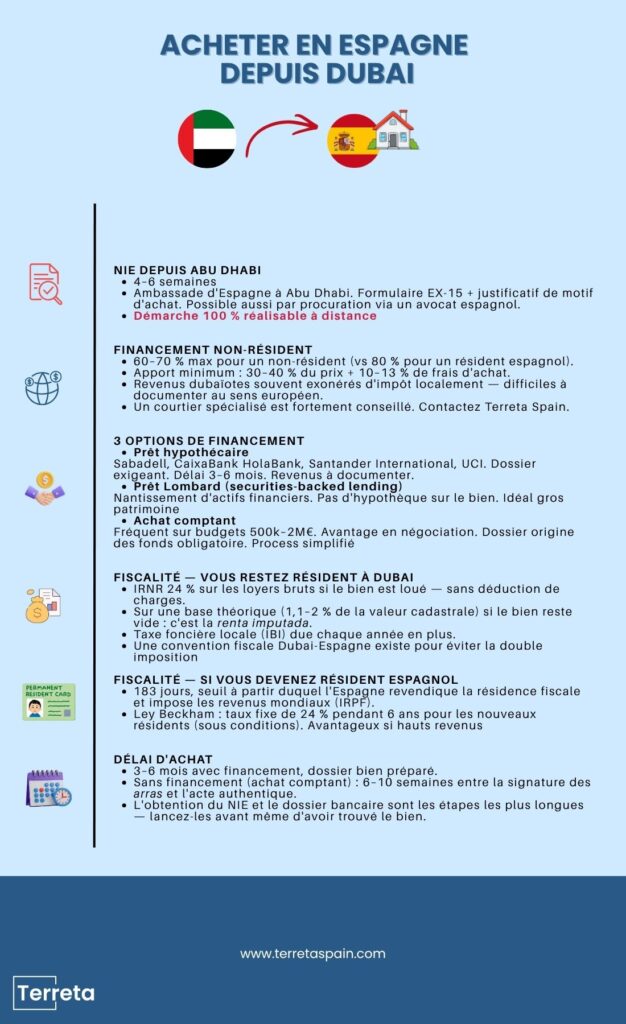
- Obtain an NIE (Spanish tax identification number).
- Have a Spanish bank account for paying local taxes.
Both of these approaches can be carried out remotely with the right support. We’ll come back to this later.
Some important details
The Spanish “Golden Visa,” which allowed applicants to obtain a residence permit in exchange for a real estate investment of at least €500,000, was abolished in April 2025. It therefore no longer serves as a pathway to entry for non-EU buyers. If the goal is to live in Spain, other options exist (non-lucrative visa, digital nomad visa, etc.); this is a separate matter from the property purchase itself.
How can I secure financing from Dubai?
A resident of Dubai can obtain a mortgage in Spain from banks that specialize in non-resident lending, such as CaixaBank, HolaBank, or Sabadell International, with a minimum down payment of 30% to 40%.
This is the most complex issue, and this is where the quality of support makes all the difference.
Spanish banks provide financing to non-residents, but under terms that differ significantly from those applied to residents. For an investor from Dubai, the rules are as follows:
- Maximum ownership share for non-residents: 60–70% vs. 80% for Spanish residents
- Minimum down payment: 30–40% + closing costs (10–12% of the purchase price)
- Maximum duration: 20–25 years, often limited by age (maximum age of 70 at the end).
Option 1: A Spanish mortgage
Several Spanish banks (Sabadell, CaixaBank, UCI, Santander International, etc.) have divisions dedicated to non-residents.
The application process is more rigorous, but it is entirely possible to obtain a Spanish loan. You must provide:
- Proof of income, translated and apostilled.
- Bank statements for the past 12 months.
- Often, a tax return from the country of residence, in this case Dubai.
The Terreta Advantage: Our teams at specialize in assisting non-resident buyers, and can connect you with a broker who specializes in financing for non-residents.
Option 2: Securities-backed lending (or Lombard loans) and asset pledging
It’s the smart move. For buyers with a substantial investment portfolio (life insurance, stocks, bonds), securities-backed lending is often the most effective solution.
Here’s how it works: your international private bank or asset manager provides you with a loan secured by your investment portfolio. You then use these funds to finance your purchase in Spain, either in full or as a supplement to a mortgage. This means the loan is not handled by a Spanish bank, but by the institution that already manages your assets.
Mechanics
For every €100 of collateralized financial assets, the bank typically lends €60 to €70. If the value of the assets falls below a certain threshold, a margin call may be triggered, and the bank may then liquidate a portion of the assets. For an investor looking to diversify their portfolio, this is often an acceptable outcome.
Potential tax benefit: You retain your assets, avoid capital gains tax, and finance your real estate investment in Spain.
Option 3: Cash Purchase
For budgets ranging from €500,000 to €2 million, cash purchases remain common among international buyers. This approach drastically simplifies the process (no banks, no financing delays) and provides a clear advantage in negotiations.
Please note: Transferring funds from Dubai to Spain is legal but must be properly documented (source of funds, bank statements); Spanish notaries and banks strictly enforce anti-money laundering regulations.
Good tip: Prepare a “source of funds” file in advance, including bank statements, proof of asset sales, pay stubs, or proof of income. This will significantly speed up the signing process at the notary’s office.

Administrative procedures
NIE: How do I get one from Dubai?
The NIE (Foreigners’ Identification Number) is the identification number required to purchase an apartment or house in Spain. Without an NIE, you cannot sign a deed of sale, open a Spanish bank account, or pay local taxes.
| ROUTE | WHERE | DEADLINE | PRACTICALITY |
| Spanish Embassy in Abu Dhabi | Abu Dhabi | 2–6 weeks | RECOMMENDED |
| In person in Spain (police station) | Spain | 1–3 weeks | EFFECTIVE |
| Through an attorney with power of attorney | Remotely | 3–8 weeks | PRACTICAL BUT SLOWER |
Steps to obtain your NIE from Dubai:
- Gather the required documents: a valid passport, Form EX-15 (NIE), and proof of purpose (a preliminary sales agreement or a letter of intent to purchase is sufficient)
- Make an appointment at the Spanish Embassy in Abu Dhabi; wait times vary, so plan for 2 to 6 weeks
- Submit the application in person or through an attorney authorized by a notarized power of attorney
- Receiving your NIE by mail or picking it up in person
- Opening a Spanish bank account (possible with your NIE, passport, and supporting documents)
Practical information:
Spanish Embassy in Abu Dhabi:
96 Al Ladeem Street, Al Nahyan Commercial Buildings
P.O. Box 46474 – Abu Dhabi
Email: emb.abudhabi@maec.es
Tel: +971 (02) 407 90 00
Platform for scheduling an appointment to obtain your NIE directly in Spain: https://sede.administracionespublicas.gob.es/pagina/index/directorio/icpplus
Terreta Spain’s recommendation: Hire a Spanish lawyer or, better yet, your Terreta Spain agent from the very start of the project to handle the NIE application on your behalf. This will allow you to begin the process while you’re still searching for a property, without having to travel specifically to handle the paperwork.
The power of attorney can also authorize your Terreta Spain agent to sign the preliminary agreement and even the final deed on your behalf. This is ideal for buying a property without having to travel.
The TIE: If you're planning to move to Spain
If your plans change (a second home now, a primary residence in a few years), an additional document will be required: the TIE (Tarjeta de Identidad de Extranjero, the identity card for non-European foreigners).
This applies to individuals who spend more than six months a year in Spain. For a citizen of Dubai, it is mandatory once you become a resident of Spain.
This document contains your personal information, your photo, your fingerprints, and your NIE number. It is valid for 5 years.
To get it:
- Have a valid NIE
- Make an appointment with the Spanish National Police
- Fill out form EX-17
- Pay a tax of €12 to €15 using Form 790, code 012
- Provide proof of status (visa, residence permit, financial resources)
- Have your documents translated by a certified translator if necessary
The application must be submitted within 30 days of your arrival in Spain.
In summary: You need an NIE to buy property in Spain. You need a TIE if you decide to live there. For a remote purchase from Dubai or any other country in the Middle East (such as a second home or rental investment), only the NIE is required initially.
Spanish Taxes: What You'll Pay Based on Your Situation
Owning property in Spain without residing there creates tax obligations in Spain, even if you do not receive any rent.
Starting Point: The Dubai–Spain Tax Treaty: What You Need to Know
There is a tax treaty between the United Arab Emirates and Spain (signed in 2006) aimed at preventing double taxation. It helps determine which country has the authority to tax each type of income and prevents the same income from being taxed twice.
But here’s the key point: this treaty does not eliminate the tax. It all depends on your tax residency. If you become a Spanish tax resident, Spain may tax your entire worldwide income. If you remain a resident of Dubai, certain types of income related to Spain—particularly real estate income—remain taxable in Spain.
To get a clear picture of your situation, it is important to work with a tax specialist who specializes in international cases. We recommend Delaguía y Luzón, with whom we work regularly.
Today: You remain a resident of Dubai
Owning property in Spain without residing there creates tax obligations in Spain, even if you do not receive any rent.
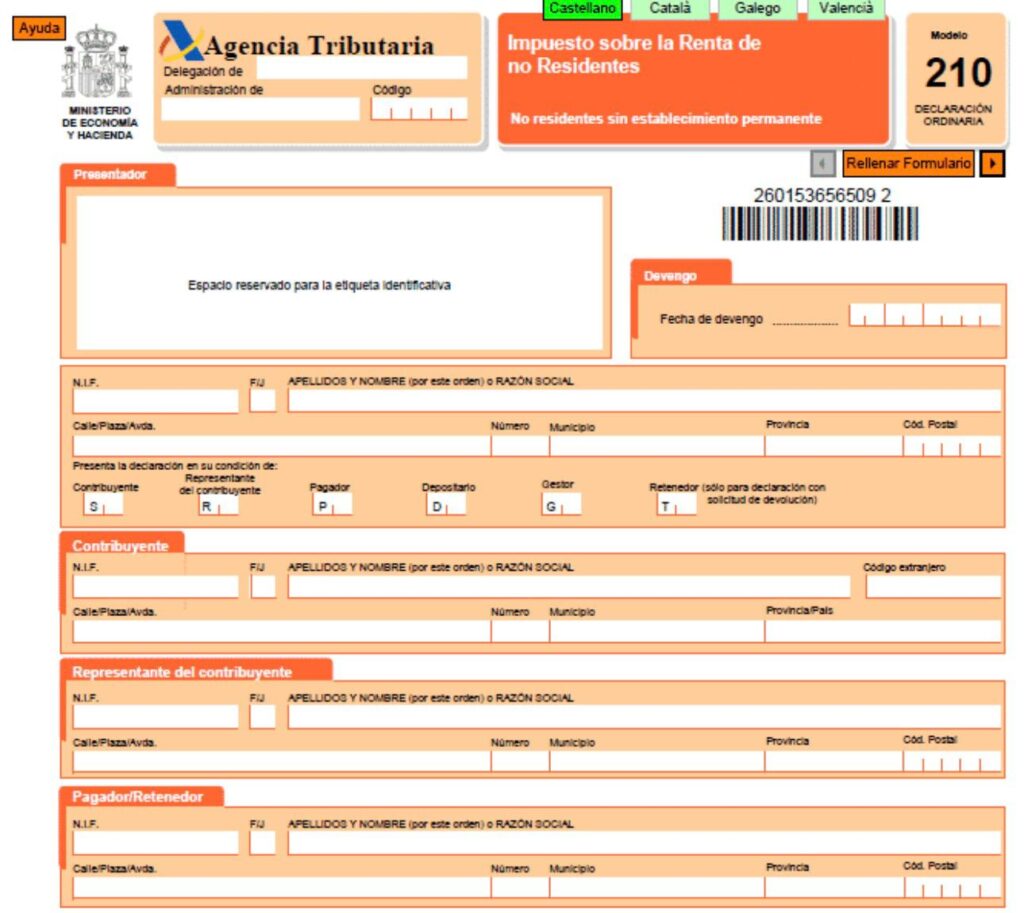
As a non-EU resident, you are subject to the IRNR (Impuesto sobre la Renta de No Residentes) at a rate of 24%, compared to 19% for EU residents. This tax applies in two ways depending on how the property is used:
- If the property is rented out: the tax is calculated based on gross rental income, with no option to deduct expenses (unlike for Spanish or European residents). This is an important factor to consider when calculating your return on investment.
- If the property remains vacant: a flat-rate tax is still due, calculated based on a theoretical rental value ( the “renta imputada”), which is generally 1.1% or 2% of the property’s assessed value, taxed at a rate of 24%. For a property with an assessed value of €200,000, this amounts to approximately €440 to €880 per year.
In addition, there is the local property tax (IBI, Impuesto sobre Bienes Inmuebles), which is equivalent to the French property tax and is due annually regardless of the owner’s place of residence.
If you become a Spanish resident
If your plans involve making Spain your primary residence, your tax situation will change dramatically. Spain will become your country of tax residence as soon as you spend more than 183 days there each year, and your worldwide income will be subject to taxation: rental income, dividends, pensions, and capital gains.
The Beckham Law is worth considering: this optional scheme allows new Spanish residents to be taxed at a flat rate of 24% for six years on their income from Spanish sources, subject to strict conditions (notably, no Spanish residency in the previous five years). For high-income earners, it is worth running a thorough simulation before moving to Spain.
Terreta Spain’s recommendation: For clients planning to reside in Spain, conducting a prospective tax analysis before purchasing allows you to optimize your investment structure from the outset. We work with bilingual Franco-Spanish tax firms to assist with these types of cases. Contact us.
Typical profile: the expat in Dubai who invests in Spain
This profile is fictional, but it reflects situations we regularly assist with from the UAE.
Thomas & Claire L. Sales Director / Independent Consultant
Have been living in Dubai for 6 years, with one child.
- Annual income: ~€250,000 (subject to low or no local taxes)
- Available savings: ~€600,000
- Project: Purchase of a luxury apartment or villa on the Costa Blanca or in Valencia
- Budget: €700,000 – €1 million
- Goal: rental investment + second home, with plans to return to Europe in the medium term
Their practical challenges
The project seems simple at first glance, but it has specific constraints:
- Reporting income earned abroad
Compensation often consists of multiple components (bonuses, commissions, dividends) → need to prepare a clear and organized file for a Spanish bank - Manage international cash flows
Fund transfer from the United Arab Emirates to Spain with a requirement for full traceability (source of funds) - Optimizing Tax Planning in the Short and Medium Term
Balancing non-resident status, a future return to Europe, and schemes such as the Beckham Law - Securing a remote purchase
Coordinating the steps (NIE, bank account, signature) without requiring a physical presence in Spain - Planning for Property Management
Renting out, maintenance, remote monitoring
What this means in practice
The issue is not investment capacity, but how the application is structured: international income, multiple tax jurisdictions, cash flows → everything must be consistent and properly documented.
Without this, even a strong application can be rejected by a bank or held up in the process.
Our role
Terreta Spain specializes in precisely these types of international cases:
- structuring financing with partners experienced in working with expatriates
- assistance with tax matters
- end-to-end management of the online shopping experience
Goal: to make an international project simple, secure, and feasible.
Why choose Terreta Spain for a purchase from Dubai?
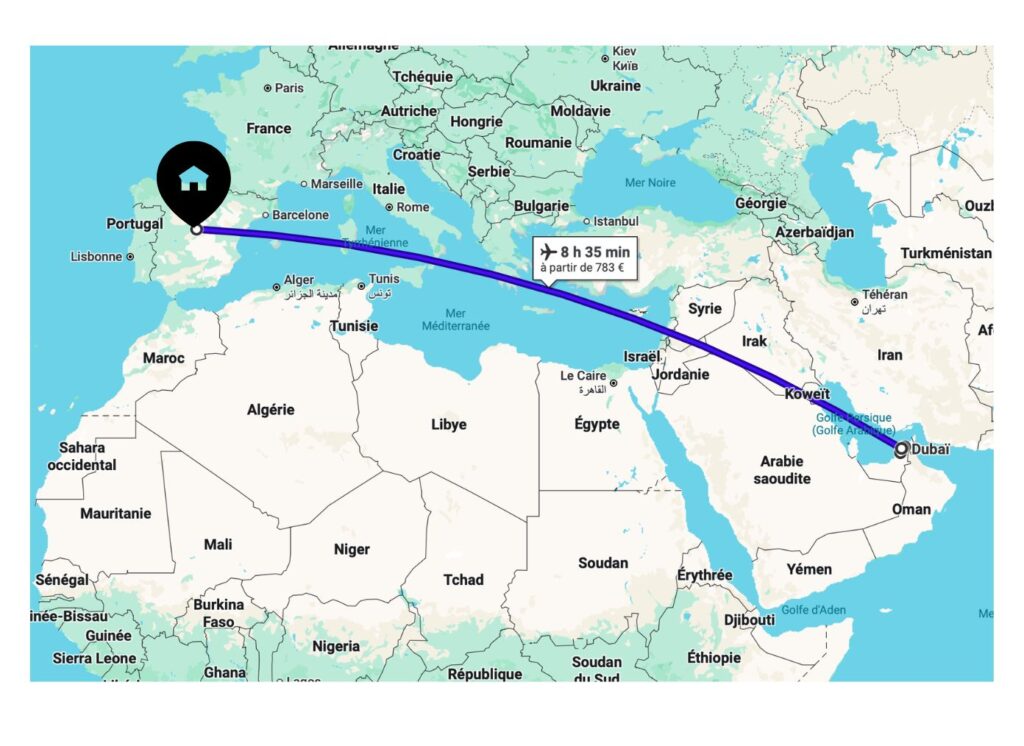
Investing from the Middle East is not the same as investing from Paris or Brussels. The challenges are different: tax-exempt income that is difficult for a Spanish bank to verify, the need for a banking network accustomed to dealing with international clients, and managing the property from over 5,000 kilometers away.
We are very familiar with this field. We work with banking contacts who specialize in non-EU residents, particularly for cases involving income from Dubai, and with bilingual French-Spanish tax firms capable of handling the international aspects of your project.
What we actually do:
- Selection of properties based on your criteria and investment plan. Property inspections and administrative and legal due diligence prior to purchase.
- Profitability analysis and forward-looking tax simulation.
- Preparation of the financing application with our specialized banking partners.
- Post-purchase support: rental management, repairs, and even resale.
Are you interested in investing in Spain from Dubai or elsewhere? We can help you identify the best opportunities and structure your investment in Europe.
Contact us for personalized support.
Explore our opportunities in Spain
And for more information, check out our resources:
- Our Guide to Buying Property in Spain
- Mortgages in Spain
- Middle East: Is Now the Right Time to Invest in Europe?
- Obtain Your Alien Identification Number
- Costs associated with buying property in Spain
- Power of Attorney in Spain (poder notarial)
- Capital gains and plusvalía in Spain
- Rental Taxation in Spain
- Shopping in Spain from Qatar
- Shopping in Spain from Kuwait
- The End of the Golden Visa in Spain
Frequently Asked Questions
Is it possible to buy property in Spain without ever traveling there from Dubai?
Yes. With a power of attorney (poder notarial) granted to a lawyer or your Terreta Spain agent, all steps can be handled remotely: obtaining the NIE, opening a bank account, signing the loan agreement, and signing the documents at the notary’s office. We do this regularly for our clients in the Middle East.
Can a Spanish bank provide financing to a resident of Dubai?
Yes, but the requirements are more stringent than for European residents. Some Spanish banks, such as Sabadell and CaixaBank (HolaBank), have divisions dedicated to non-residents. The main challenge for Dubai residents is proving their income; since it is often exempt from local taxes, it can be difficult to verify its value under European standards. A specialized broker makes all the difference.
Can funds be transferred from a UAE account to Spain without any restrictions?
Yes. Money transfers are permitted without any specific restrictions. However, Spanish banks may request supporting documentation (source of funds, income, contracts), and certain amounts must be reported. The transfer itself is not subject to tax.
Do Spanish banks recognize income that is tax-exempt in the UAE?
Yes, if they are justified. But be careful: being exempt in the UAE does not mean you are exempt in Spain. If you are a Spanish tax resident, this income may be taxable, except in special cases such as the Beckham Law.
How much money do you need to set aside to buy property in Spain from Dubai?
At least 30% to 40% of the property’s price, plus closing costs (10% to 12% of the price: property transfer tax, notary fees, registration fees, and real estate agent’s commission). For a property priced at €500,000, you should therefore expect to have a down payment of at least €200,000 to €260,000.
Is the Spanish Golden Visa still available?
No. The Spanish Golden Visa program, which allowed individuals to obtain a residence permit in exchange for a real estate investment of at least €500,000, was discontinued in April 2025. If your goal is to reside in Spain, other options are available: non-lucrative visa, digital nomad visa, etc. Purchasing real estate remains possible and unrestricted, but it no longer automatically entitles you to a residence permit.
How do I get an NIE from Dubai?
There are two main options: go through the Spanish Consulate in Abu Dhabi, or hire a Spanish lawyer or your Terreta Spain agent to obtain the NIE on your behalf using a notarized power of attorney. We recommend the second option so you can start the process while you’re still looking for a property, without having to wait for an appointment at the consulate.
What is a Lombard loan, and is it available in Dubai?
A Lombard loan, also known as securities-backed lending or a Lombard loan, allows you to borrow against financial assets (life insurance policies, stocks, bonds) without having to sell them. Your international private bank typically lends 60 to 70% of the value of the pledged assets. This service is available in Dubai through the major international private banks operating in the region. You then use these funds to finance the purchase in Spain. This is a solution particularly suited to expatriates in Dubai with significant financial assets: it avoids triggering capital gains tax upon the sale of the assets while financing the real estate.
Is there a tax treaty between Dubai (the UAE) and Spain?
Yes. A tax treaty exists between Dubai (the UAE) and Spain to prevent double taxation. It was signed in 2006 and allows for the allocation of taxing rights between the two countries, thereby preventing double taxation on the same income.
However, it does not allow you to avoid paying taxes: tax residency remains the determining factor. A Spanish tax resident is taxed in Spain on their worldwide income, while a non-resident remains subject to tax in Spain on their income from Spanish sources (such as rental income).
What are the tax implications for a Dubai resident who purchases real estate in Spain?
Several levels of taxation come into play. In Spain, all non-EU residents are subject to the 24% IRNR tax on rental income if the property is rented out, or on a theoretical basis (the “renta imputada”) if it remains vacant. Local property tax (IBI) is due annually. If you eventually become a Spanish resident, Spain will tax your worldwide income; the Ley Beckham may be advantageous depending on your income level, and the timing of the property’s resale will have a direct impact on capital gains tax. This matter warrants a personalized tax assessment before any decision is made.
How long does it take to make a purchase in Spain from Dubai?
On average, it takes between 3 and 6 months for a well-prepared application with financing. Without financing (cash purchase), the process can take as little as 6 to 10 weeks from signing the deposit agreement to the final deed. Obtaining the NIE and putting together the banking application are often the most time-consuming steps, which is why it’s best to start them as early as possible—ideally even before you’ve found the property.
Does Terreta Spain work exclusively with French nationals in Dubai?
No. We assist anyone wishing to buy property in Spain from the Middle East, regardless of their nationality: French, Emirati, British, American, etc. Our team speaks French, Spanish, English, and Dutch.