
Terreta Spain, updated in June 2026
At Terreta Spain, we are increasingly encountering this line of reasoning: once real estate holdings in Spain reach a certain level, a Spanish SL alone is no longer sufficient. Not because it is ineffective—it remains the standard structure—but because issues such as repatriating profits to the country of residence, transferring assets to heirs, and protecting one’s overall wealth come into play. This is where the holding company plus Spanish SL structure comes into play. Here is what we recommend to our clients.
Are you interested in investing in Spain? Contact our team.
Reminder: Why a Spanish SL?
The SL (Sociedad Limitada) is the structure most commonly used by foreign investors to own real estate in Spain. It allows for taxation under the Impuesto sobre Sociedades ( IS) at a rate of 25% on net income, compared to 19% on gross income when holding property in one’s own name for an EU resident, or 24% on gross income for a non-EU resident (Article 25, Law 5/2004 IRNR).
Above all, it allows you to deduct all expenses:
- Loan Interest
- IBI (property tax)
- Condominium
- Insurance
- Rental Management Fees
- Depreciation of the property (2% per year of the building’s value, according to the AEAT’s official table, “Commercial, Administrative, Service, and Residential Buildings”)
For more information:
Are you ready to invest? Contact a Terreta Spain expert.

Why set up a holding company above the SL?
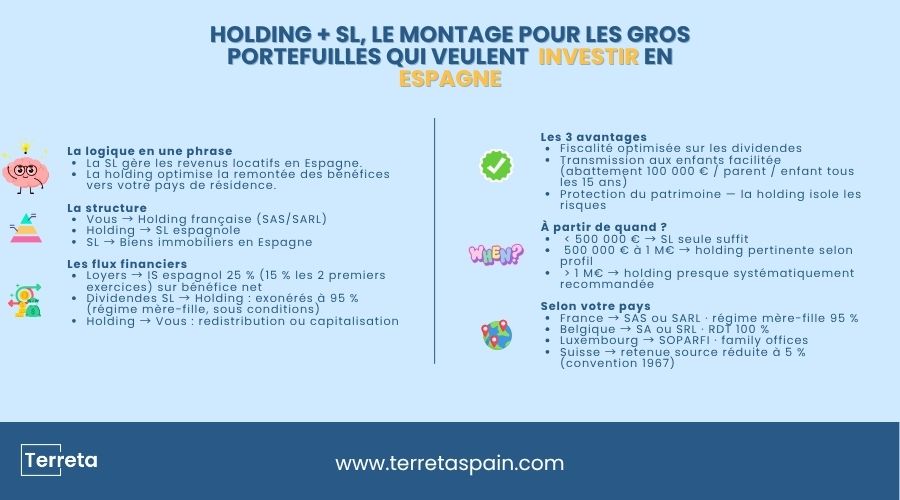
The logic is quite simple: the SL effectively manages rental income in Spain. But when profits are distributed to the partner—an individual residing in France, Belgium, or Switzerland—they are taxed again in the country of residence, either as dividends or upon the sale of the shares.
Tip: The holding company acts as an intermediary between you and the Spanish SL. Instead of paying dividends directly to you, the SL pays them to your holding company, which capitalizes them, reinvests them, or redistributes them in a way that optimizes your wealth.
The three main reasons for establishing a holding company:
1. Tax Optimization of Dividends
In France, a parent company may qualify for the parent-subsidiary tax regime (Article 145 of the General Tax Code) if it has held at least 5% of the subsidiary for more than two years. Dividends paid from the Spanish SL to the French holding company are then 95% tax-exempt; only a 5% portion of expenses and charges is subject to French corporate income tax.
2. Simplified Estate Transfer
Of interest to high-net-worth individuals: Transferring shares in a holding company to one’s children is more tax-efficient than directly transferring real estate or shares in a Spanish SL. The gift tax exemptions in France (€100,000 per parent and per child every 15 years) apply to the value of the holding company’s shares.
3. Asset Protection and Centralization
Another advantage is that the holding company isolates risks: if the Spanish SL is involved in a lawsuit or faces a claim, the holding company—and the assets it holds elsewhere—remain protected. It also allows for the centralized management of assets across multiple countries within a single entity.
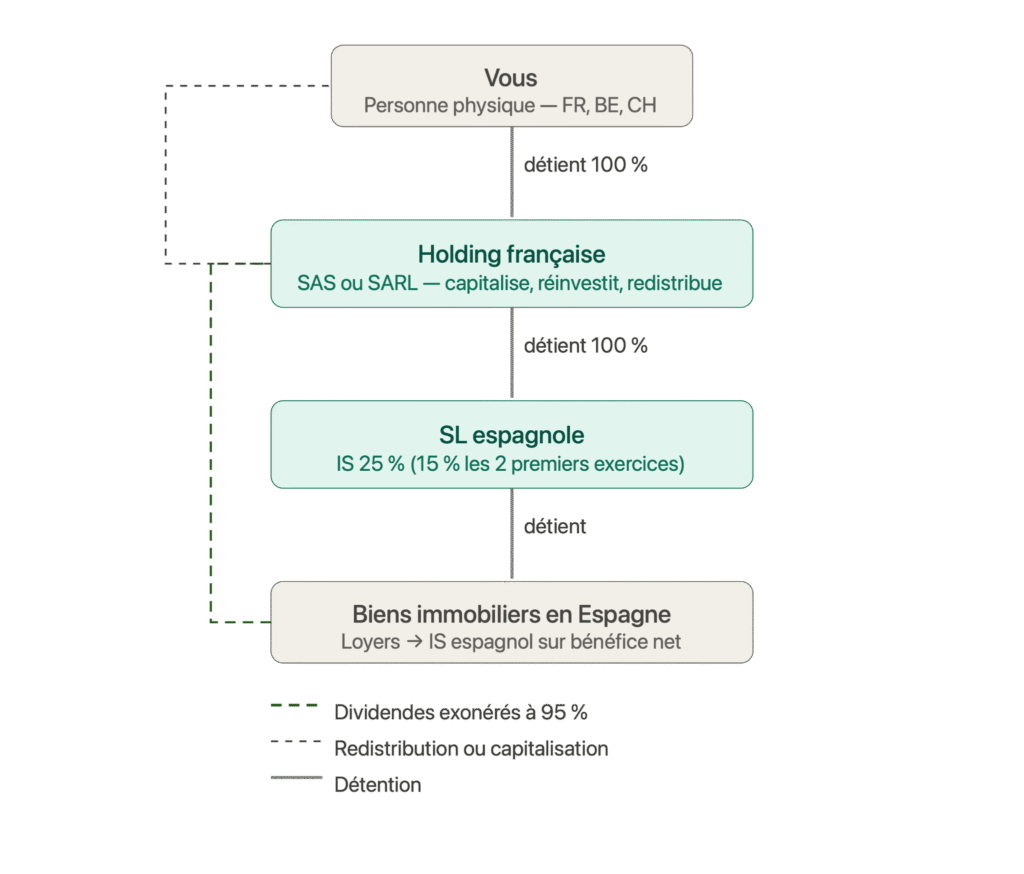
The Standard Structure of the Montage
The most common scenario for a French investor:
| You (an individual residing in France) own 100%↓ A French SAS or SARL holding company, which wholly owns↓ a Spanish SL, which owns↓ Real estate in Spain |
Cash flows:
- Rental income from Spain is reported on the SL form → Spanish corporate income tax at 25% (or 15%) on net income
- Dividends are paid from the subsidiary to the holding company → 95% tax exemption (parent-subsidiary regime, subject to certain conditions)
- The holding company reinvests , capitalizes, or distributes funds according to your wealth management strategy
What type of holding company should you choose?
A holding company can be incorporated in any country, but its country of tax residence determines the applicable rules. Here are the most common structures based on the investor’s country of residence:
France: SAS or SARL Holding Company
An SAS and an SARL are the two most common legal structures for a French holding company. The choice depends on your situation.
- The SAS is the most flexible: it offers flexible governance, facilitates the entry of third-party investors, and allows for the gradual transfer of shares to be organized on a case-by-case basis through the articles of incorporation. It is the preferred choice for complex asset structures or projects involving multiple partners with different profiles.
- An SARL is better suited to simple family-owned businesses: it offers a more rigid structure but is more clearly defined legally, and the social security provisions for the majority owner may be more advantageous depending on their personal circumstances.
In both cases, the parent-subsidiary rule applies if the conditions are met (5% ownership, at least 2 years).
Belgium, holding company (SA or SRL)
Belgium has a mechanism equivalent to the French parent-subsidiary regime: the Definitively Taxed Income (RDT) regime. Subject to certain conditions (holding at least 10% of the capital or an acquisition value of at least €2.5 million for at least one year), dividends paid from a Spanish SL to a Belgian holding company are almost entirely exempt from Belgian corporate income tax.
Please note: Starting in fiscal year 2026, large companies with an ownership interest of less than 10% must also record that interest as a financial asset in order to qualify for the benefit.
Luxembourg: SOPARFI
The Luxembourg-based financial holding company is a holding structure widely used by family offices.
Advantages: parent-subsidiary structure, the Luxembourg-Spain tax treaty, and a stable, internationally recognized legal framework.
Switzerland: Swiss holding company
Possible, but more complex. Switzerland is not part of the EU, which limits access to the European parent-subsidiary regime. Bilateral agreements between Switzerland and Spain apply, but tax planning is less straightforward than within the EU. The Switzerland-Spain tax treaty (in effect since 1967) provides for a reduced withholding tax of 5% on dividends paid by a Spanish SL to a Swiss holding company that owns more than 25% of the capital, compared to 15% under general circumstances. Real estate income remains taxable in Spain.
For what level of net worth is this investment strategy appropriate?
The holding company + SL structure results in additional fixed costs: setting up and managing the holding company, accounting in two countries, filing financial statements, and legal fees.
In practice:
- For Spanish real estate holdings valued at less than €500,000: an SL alone is generally sufficient.
- Between €500,000 and €1 million: A holding company structure becomes a viable option if you own multiple properties, have significant recurring profits, or are planning to pass your business on to the next generation.
- For amounts over 1 M€: a holding company structure is almost always recommended.
For family offices managing portfolios worth several million euros, a holding company structure is the norm, often supplemented by a more complex structure (country-specific sub-holdings, division of shares, etc.).
To learn more, read our feature: Investing in Spain with a family office
Points to Watch For
1. The Economic Substance of the SL
An SL must demonstrate that it engages in genuine economic activity (Article 5.1, Spanish Corporate Income Tax Law 27/2014). In practice: signed lease agreements, management agreements, and utility bills. Without this substance, the Spanish tax authorities may challenge the tax benefits.
2. The applicable tax treaty
Each country has its own tax treaty with Spain, which determines how dividends, capital gains, and interest are treated. Always check the tax treaty specific to your country of residence before structuring your arrangement.
3. The cost of implementation and annual maintenance
Expect to pay approximately €2,000 to €4,000 per year for accounting and tax management of the two entities (holding company + SL), depending on the complexity of the situation and the service providers you choose.
4. Tax Treatment of the Sale of SL Shares
Please note that selling your Spanish SL is not tax-neutral. The Franco-Spanish tax treaty explicitly states (Article 13) that gains from the sale of shares in a company whose assets consist primarily of real estate located in Spain remain taxable in Spain, even if you sell the shares rather than the property directly. Structuring the transaction through an SL therefore does not exempt you from Spanish capital gains tax. The applicable rate is that of Spanish corporate income tax if the sale occurs at the SL level, or that of the IRNR (non-resident income tax) if you sell the shares as a non-resident. France then applies a tax credit to avoid double taxation. This point must be anticipated from the outset when structuring the arrangement, particularly if a future exit is planned.
See our article on the France-Spain Tax Treaty (link to be added once published).
How Terreta Spain is involved in this arrangement
Terreta Spain operates on the Spanish side:
- Sourcing of goods;
- Coordination of the formation of the limited liability company with the law firm Delaguía y Luzón in Valencia
- Rental Management and Construction Oversight
- For the holding company in your country of residence, we can put you in touch with the right people—tax specialists and attorneys who specialize in cross-border structures.
The goal: to provide you with a trusted point of contact on the Spanish side who works closely with your advisor on the French, Belgian, or Swiss side.
Are you interested in structuring your real estate investment in Spain through a holding company and SL arrangement? Schedule a call with our team.
FAQ
How many properties should you have before considering a holding company?
There is no minimum number of properties required; it is more a matter of total net worth, the income generated, and the strategy for passing on the estate. In practice, this arrangement becomes relevant when Spanish assets total at least €500,000 and/or net rental income exceeds €40,000 per year.
Does the holding company have to be located in my country of residence?
Not necessarily, but that is the most common scenario. The holding company can be established in any country, but its country of residence determines the tax treatment of dividends and capital gains. It is essential to choose a country that has a favorable tax treaty with Spain and an advantageous parent-subsidiary regime.
Can there be more than one Spanish limited liability company (SL) under the same holding company?
Yes. It’s actually a common strategy for investors with multiple projects (one LLC per region, property type, or partner). The holding company oversees the entire portfolio and centralizes asset management.
What is the difference between an active holding company and a passive holding company?
An active holding company plays an active role in managing its subsidiaries (strategic advice, shared services). A passive holding company simply holds the shares. This distinction is important for certain French tax benefits (such as the Dutreil Pact for business succession); be sure to check with your tax advisor.
Is this package suitable for a group purchase by a family?
Yes. A holding company makes it possible to organize governance among several family members or partners, with clear rules for exiting the company and transferring ownership. A partners’ agreement at the holding company level sets forth the rights and obligations of each party.
For more information:
- Should I invest as an individual, through an SL, or through a SOCIMI?
- Spanish SL vs. French SCI
- Investing in Spain with a family office
- The Beckham Diet in Spain
- The steps involved in buying property in Spain
- Set Up a Spanish SL for Your Real Estate Investments
- Spanish SL vs. French SCI for Buying Property in Spain
This article is intended for general informational purposes only and does not constitute personalized tax or legal advice. Each situation should be reviewed with a Spanish tax attorney and a tax advisor in your country of residence. The tax rates and rules mentioned are those in effect as of June 2026 and are subject to change.