
Caption: Vacation rentals in Spain: What steps do you need to take to rent legally?
Updated in March 2026
The vacation rental market in Spain is one of the most dynamic in Europe, but also one of the most heavily regulated. With more than 94 million tourists visiting each year, 330,000 legal vacation rentals (INE), and several thousand that are not, Spain has thoroughly overhauled its legal framework between 2025 and 2026.
A property is considered a short-term rental when it is rented out repeatedly for short periods—up to a maximum of 31 days. Beyond that, it falls under the category of seasonal rental (alquiler de temporada), which is subject to a different and significantly less restrictive legal framework.
The Terreta Spain guide to vacation rentals in Spain tells you everything you need to know before diving in blindly. Spoiler: it could end up costing you a fortune.
Where can you still rent a car for leisure travel in Spain?
Why have regulations become stricter?
The boom in platforms like Airbnb and Booking has transformed thousands of residential properties into tourist accommodations, particularly in major cities and along the coast. In Madrid, Barcelona, Valencia, Alicante, and elsewhere, the attractive returns promised by this type of rental have enticed property owners and disrupted the housing market.
The vacation rental industry is currently at a turning point, with new national regulations, stricter enforcement, and expanded powers for homeowners’ associations.
The government's response is structured around three objectives:
- Combating tax evasion;
- Restore balance to the housing market in areas under pressure from tourism;
- Professionalize the sector.
Caption: El Carmen neighborhood, Valencia
Photo: Terreta Spain
The legal framework in 2026: three key aspects to understand
Spanish regulations are based on a three-tiered structure. It is essential to understand this structure before moving forward.
National level: requirements applicable throughout Spain
Since July 2025, Spain has been implementing one of Europe’s most ambitious regulations on short-term rentals, in accordance with the European regulation and Royal Decree 1312/2024. This legal framework, which became fully operational on January 1, 2026, establishes a single registry for short-term rentals and a one-stop digital portal managed by the Ministry of Housing.
Specifically, two national requirements apply to everyone:
- As of July 1, 2025, all vacation rentals must havea national registration number obtained through the Ventanilla Única Digital de Arrendamientos (VUD). Without this number, platforms such as Airbnb or Booking will refuse to publish the listing.
- The Digital One-Stop Shop also requires the submission of a guest registry via the SES.HOSPEDAJES system. Up to 21 fields of information must now be submitted within 24 hours of the guest’s arrival.
Regional level: the tourism license
Each autonomous community issues its own license with its own requirements. The designations vary: VUT in Andalusia and Valencia, HUT in Catalonia, and ETV in the Balearic Islands.
- Please note that the regional license and the VUD number are complementary—both are required.
Local level (condominium association and city hall)
Since April 3, 2025, the reform of the Condominium Act (LPH) has allowed condominium associations to restrict or prohibit tourist activities by a three-fifths majority vote. Condominium fees may also be increased by up to 20% for properties used for tourist purposes.
Terreta Spain’s advice: Before purchasing a unit in a building, review the minutes of the general meetings to ensure that no restrictions have been approved.
For example: one of the Terreta team members almost bought a property in Valencia, in the port district (El Grau), in a building where the homeowners’ association was in the process of drafting new bylaws to prevent short-term rentals. It would have been a shame to miss out on that information.
Required documents
Regardless of the region, certain documents are generally required in order to rent the property legally.
- Property title
- Certificate of Occupancy
- Energy performance certificate
- Liability insurance
- Urban planning compliance (mandatory in certain regions, such as the Valencian Community)
- Disclaimer
The average processing time for a tourism license is 1 to 3 months, depending on the region and the complexity of the application.
As for the administrative fees for submitting an application, they vary by region, but generally range from €30 to €120, depending on the autonomous community and the complexity of the application.

Vacation Rentals in Spain: Rules Regarding Furnishings
Regardless of the region, accommodations intended for vacation rentals must be furnished and equipped. The amenities generally required are:
- Washing machine
- Cooktops
- Refrigerator
- Wi-Fi connection
The landlord must also provide each tenant with a 24-hour emergency contact number upon moving in.
Do you have a question? Contact a Terreta Spain advisor
Region by region: what applies in your area
Andalusia: accessible but changing
Andalusia is the autonomous community with the highest number of tourist accommodations (more than 80,000). At present, the process for obtaining a license is relatively straightforward: all that is required is a simple sworn statement filed with the Andalusian Tourism Registry (RTA) and a certificate of occupancy. Air conditioning is mandatory between May and September, and heating between October and April.
Please note, however, that in Málaga, since January 2025, a three-year moratorium has prohibited the registration of new vacation rentals in 43 oversaturated neighborhoods where vacation rentals account for more than 8% of the residential housing stock. Marbella, on the other hand, does not yet have any specific restrictions in place.
Severity level: mild to moderate — fines of up to €100,000.
Catalonia (Barcelona): Spain's most restrictive market
In Catalonia, a license is required and valid for five years, with strict quotas. In Barcelona, the goal is to phase out licenses by 2028–2029 —current licenses will not be renewed.
The Special Urban Plan for Tourist Accommodations (PEUAT) effectively blocks almost all new licenses in the city center. Fines can reach €600,000.
Terreta Spain’s advice: If you’re investing in Catalonia for short-term rentals, consider outlying areas or choose a property with a separate entrance. And above all, be prepared for the possibility that existing licenses may not be renewed.
Severity level: very strict — fines of up to €600,000.
Valencia Region (Valencia, Alicante, Gandia): Caution is advised
Valencia City — The "Five Locks" Regulation
In the Community, a planning compliance report issued by the town hall is required before any license application can be submitted. Key boxes on the street are prohibited, the maximum rental period per tenant is 10 days, and fines can reach up to €600,000.
After a two-year moratorium, Valence will implement its new “five-lock” regulations starting in April 2026. The regulations impose five cumulative requirements—all of which must be met simultaneously:
- Less than 2% of housing units in the neighborhood are vacation rentals
- Less than 5% in the cadastral block
- Fewer than 8% of tourist accommodations relative to the registered population
- Less than 15% of commercial spaces converted into housing
- Private entrance required; no neighbors on the lower floors
Added to this is the requirement for approval from three-fifths of the condominium owners, which has been mandatory since the reform of the Condominium Act. According to Juan Giner, the city councilor for Urban Planning, this regulation makes it “virtually impossible” to create new tourist apartments in Valencia.
Advice from Terreta Spain: Seize this opportunity before the new rules take effect: a one-year transitional measure allows owners to convert their vacation rentals into standard residences, provided they meet habitability standards.
Outside of Valencia, in the Valencian Community, the regulations are less strict. Gandia, for example, has much more favorable regulations than the city of Valencia itself. This is one of the reasons for its excellent returns (~10% gross).
Renting for more than 10 days: our favorite tip
In Valencia, a rental is considered “tourist-oriented” (VUT) if it lasts fewer than 10 nights—and therefore requires a license. Don’t have a license? Offer stays of at least 11 nights: this falls outside the VUT category, and you can list on Airbnb legally.
This tip applies specifically to the Valencian Community. In other regions of Spain, short-term rentals can cover stays of up to 31 days—the 11-night limit doesn’t apply there. Thanks to whom?
To learn more, check out our resources:
- How do I obtain or purchase a tourist license in Valencia?
- Gandia, Spain's No. 1 profitable destination
- Explore Gandia in 3 days
Level of strictness: moderate to strict, depending on the municipality.
Balearic Islands (Mallorca, Ibiza, Menorca, Formentera): the most expensive
The Balearic Islands have imposed a total cap of 90,000 units, a high licensing fee of €3,500, and a ban on new licenses in multi-unit buildings starting in April 2025. Licenses (ETV) are valid for five years and are renewable.
Severity level: very strict — fines of up to €500,000.
Community of Madrid: In Transition
Licenses in Madrid were suspended until February 2026, with platforms required to remove unregistered listings within 48 hours. The new municipal regulation prohibits short-term rentals in residential buildings in the historic center, unless they have separate entrances.
Severity level: moderate to strict in the central region — fines of up to €190,000.
Canary Islands: Renting for tourism is still a viable option
The Canary Islands limit tourist rentals to 10% of residential space, with decisions made at the municipal level and a tourist tax in effect.
Severity level: moderate — fines of up to €200,000.
Andalusia (excluding Málaga, Murcia, and Almería) / Galicia — the most accessible regions
Rural areas in Aragon, Murcia, and Castile and León have more flexible procedures and less frequent inspections. Galicia has a simplified framework, with restrictions mainly in historic districts.
For investors looking to enter the tourism market without excessive administrative burdens, these areas offer a good balance between profitability and regulatory accessibility.
Summary table by region
| Region | Bachelor's Degree | Severity | Maximum fines |
| Andalusia | VUT — Affidavit | Flexible | ~100 000 € |
| Málaga city | VUT + moratorium on 43 neighborhoods | Intermediate | ~100 000 € |
| Catalonia / Barcelona | HUT — strict quotas, scheduled to end in 2028 | Very strict | 600 000 € |
| Valencian Community | VUT + urban planning compatibility | Intermediate | 600 000 € |
| Gandia | VUT — favorable legislation | Flexible | — |
| Balearic Islands | ETV — 90,000 spots available, €3,500 | Very strict | 500 000 € |
| Madrid | VUT — moratorium on the historic district | Strict | 190 000 € |
| Canary Islands | VUT — 10% residential quota | Intermediate | 200 000 € |
| Murcia / Almería | VUT — flexible procedure | Flexible | Variable |
| Galicia | VUT — Restrictions in Historic Districts | Flexible | Variable |
Taxation of Vacation Rentals
Income from vacation rentals is taxable in Spain.
- For non-resident EU/EEA nationals, the rate is 19% of net income (see our fact sheet on IRNR, the Non-Resident Income Tax).
- For non-residents outside the EU, the tax rate is 24% of gross income (IRNR).
- For tax residents in Spain, these are included inthe IRPF, the personal income tax.
A development to watch closely: the Spanish government has introduced a bill to impose a 21% VAT on tourist rentals of less than 30 days in municipalities with more than 10,000 residents. If passed, this measure could take effect in 2026, ahead of the European deadline of July 2028. This would represent a major change—currently, the vast majority of tourist rentals are not subject to VAT.
Income from short-term rentals must be reported using Form 210 for non-residents, on an annual basis starting in 2024.
For more information, see our comprehensive guide to rental taxation in Spain for non-residents.
Risks in the Event of Non-Compliance
It’s no longer an urban legend: renting a vehicle without a license and without a VUD number now carries severe penalties.
Fines range from €2,000 to €600,000 depending on the region, with the possibility of license suspension or revocation, removal of listings from platforms, and the risk of criminal prosecution for serious violations.
Since January 2026, platforms have been submitting monthly data on all active assets to the Agencia Tributaria (the tax authority), facilitating cross-checks. The risk of an audit has never been higher.
- In 2025, in Valencia, fines increased sevenfold.
- By the fall of 2025, the Spanish government had already removed more than 50,000 illegally rented properties from the market (Euronews).
Vacation rental or long-term lease: how do you choose?
In light of stricter regulations, many property owners are questioning whether short-term rentals are a better option than long-term rentals.
Vacation rentals: Who are they for?
- Homeowners in areas with high tourist appeal (Gandia, Costa del Sol, Balearic Islands—excluding quota-restricted areas)
- Properties with private entrances in major cities
- Property owners willing to invest in property management or to hire a property management company
Long-term rentals: Who are they for?
- Properties located in areas with high residential rental demand (Valencia, Madrid, Barcelona)
- Non-resident property owners seeking passive management
- Areas where tourist licenses are suspended or fully allocated
Short-term rentals (alquiler de temporada): the little-known alternative.
These are contracts ranging from 1 to 12 months, often aimed at business travelers, students, or digital nomads. They are not subject to tourism regulations but offer greater flexibility than traditional long-term leases. This option is becoming increasingly popular in major Spanish cities.
Shared living: a highly cost-effective choice
In the face of stricter regulations, shared housing is emerging as a highly effective alternative to short-term rentals. With no license required and no administrative burdens, it can generate 30% higher returns than a traditional rental—a four-bedroom apartment in Valence can thus bring in €1,600 to €2,000 per month, compared to €900 to €1,100 for a traditional rental.
The concept: renting out rooms on a per-room basis to students, young professionals, or professionals on the move. Demand is strong and consistent in university towns such as Murcia, Valencia, and Madrid.
Terreta Spain’s advice: Shared housing isn’t something you can just wing. You need a property with at least three bedrooms in a good location, targeted renovations (soundproofing, a functional kitchen, adequate bathrooms), and more active management than with a traditional rental—frequent tenant turnover, maintenance of common areas. Plan to delegate.
That’s exactly where Terreta Spain comes in: our property renovation service transforms a standard apartment into an optimized and profitable shared living space, from design to completion.
Contact the experts at Terreta Spain for a consultation on your renovation project.
What it costs if you don't follow the rules
| Location | Penalty |
| Rental without a license | €2,000 to €600,000, depending on the region |
| Ad without a VUD number | Immediate removal + fine |
| Failure to report income | 25% surcharge |
| Repeated serious violation | Criminal proceedings |
In Valencia, fines increased sevenfold in 2025. Since January 2026, platforms have been submitting monthly data on all active property owners to the Tax Agency. The risk of an audit has never been higher.
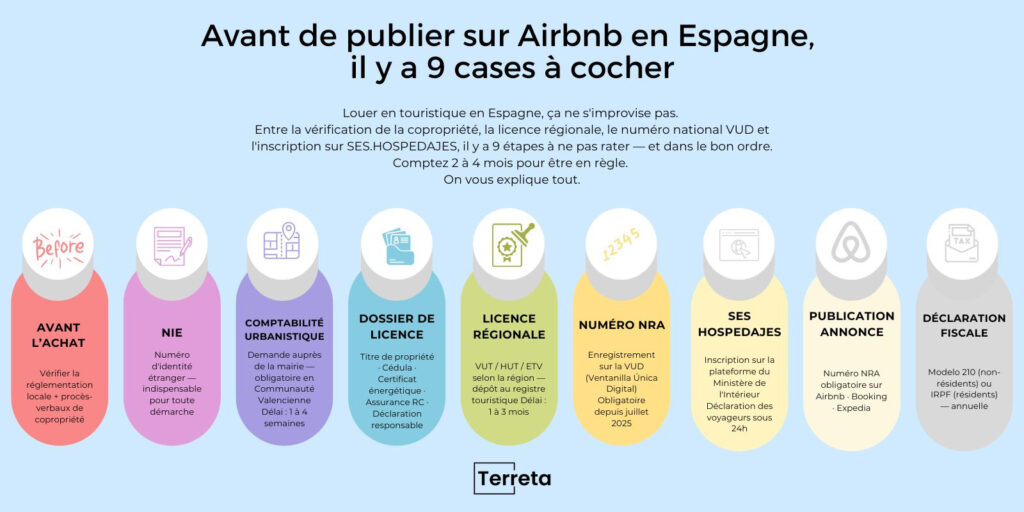
Terreta Spain's Checklist Before You Start a Vacation Rental Business
Check whether the city hall permits short-term rentals in the area
View the condominium meeting minutes (3/5 majority vote since April 2025)
Obtain planning approval (required in certain regions)
Gather the documents required for the regional license (ID card, energy certificate, liability insurance)
Register on the VUD to obtain your national ID number
Register on SES.HOSPEDAJES: the Spanish Ministry of the Interior’s official system for traveler registration.
Display the VUD number on all listings
Check the applicable tax regime (resident / EU non-resident / non-EU)
Plan for a potential 21% VAT rate if the law is passed in 2026
Contact a Terreta Spain advisor

Vacation Rentals in Spain: A Glossary of Tools and Reference Materials
- NRA / NRUA — Rental Registration Number The unique registration number assigned to each vacation rental in Spain. Required as of July 2025 for listing on any online platform. It is obtained through the VUD after registering the regional license. → How to obtain the NRA
- VUD — Digital One-Stop Shop for Rentals The Digital One-Stop Shop for Rentals, established by Royal Decree 1312/2024. This is the national platform where you register your property to obtain the NRA number. Mandatory as of July 1, 2025. → Digital One-Stop Shop
- SES.HOSPEDAJES: The Spanish Ministry of the Interior’s platform for reporting travelers. Each owner or manager must submit up to 21 pieces of information per traveler within 24 hours of arrival. Mandatory since December 2024. Exception: Catalonia (Mossos d’Esquadra) and the Basque Country (Ertzaintza) have their own systems. → SES.HOSPEDAJES → Official Ministry of the Interior website
- VUT — Tourist Accommodation License The official name of the tourist license in Andalusia, the Valencian Community, Madrid, and most other autonomous communities. It is the regional document that legally authorizes tourist rentals.
- HUT — Tourist Accommodation The Catalan equivalent of the VUT. A tourist license issued in Catalonia, subject to PEUAT quotas in Barcelona.
- ETV — Tourist Accommodation License / ETVPL Tourist License in the Balearic Islands. The ETV applies to single-family homes, while the ETVPL applies to apartments in multi-unit buildings. Fee: €3,500. Valid for 5 years. New ETVPL licenses have been prohibited since April 2025.
- RTA — Andalusian Tourism Registry The official tourism registry of the autonomous community of Andalusia. It is with this registry that property owners file their sworn statement to obtain their VUT license. → Andalusian Tourism Registry
- PEUAT — Special Urban Plan for Tourist Accommodations: Barcelona’s special urban plan regulating tourist accommodations. It divides the city into zones with very restrictive rules, effectively blocking almost all new licenses in the city center. Existing licenses will not be renewed starting in 2028–2029. → PEUAT Barcelona
- LPH — Horizontal Property Act The national law governing condominiums in Spain. Amended by Organic Law 1/2025 of January 2, it now allows condominiums to ban short-term rentals by a three-fifths majority vote, effective as of April 3, 2025. → Horizontal Property Act — consolidated text → Organic Law 1/2025 — the reform
- Royal Decree 1312/2024 The founding text of the Single Rental Register and the VUD, published on December 23, 2024, in accordance with European Regulation (EU) 2024/1028. It makes national registration mandatory as of July 1, 2025. → Royal Decree 1312/2024 — BOE
- Form 210: The tax form used by non-residents to report their rental income in Spain (IRNR). Filed annually starting in 2024. It is also used to report imputed income if the property is vacant. → Form 210 — Spanish Tax Agency
- Certificate of Occupancy The Spanish certificate of occupancy, which certifies that the property meets the minimum standards for floor space, amenities, and safety required for habitation. This document is mandatory for obtaining a tourism license in all regions.
- Seasonal Rentals: Short-term rentals lasting between 1 and 12 months. These are not subject to tourism regulations and do not require a VUT license. This is an increasingly popular alternative in major cities where tourism licenses are unavailable or fully allocated.
FAQ — Vacation Rentals in Spain
Is a tourism license required everywhere in Spain?
Yes, in all regions without exception. The names vary by autonomous community—VUT in Andalusia and Valencia, HUT in Catalonia, ETV in the Balearic Islands—but the requirement has been universal since the 2025 reforms. Without a license, you face fines ranging from €2,000 to €600,000.
What is a VUD number, and how do I get one?
This has been the mandatory national identification number since July 2025 for posting a listing on Airbnb, Booking, or Expedia. Without this number, the platforms will refuse to publish the listing. It can be obtained through the Ventanilla Única Digital de Arrendamientos after registering your regional license. Both are mandatory and complementary.
What is SES.HOSPEDAJES?
This is the Spanish Ministry of the Interior’s official system for registering travelers. Whenever a tourist arrives at your accommodation, you must submit up to 21 pieces of personal information within 24 hours of their arrival. Manual submissions have not been accepted since 2025. Exception: Catalonia and the Basque Country have their own systems.
Can my homeowners' association prohibit me from renting to tourists?
Yes. Since the amendment to the Condominium Act on April 3, 2025, a three-fifths majority vote of the co-owners is sufficient to prohibit or restrict short-term rentals in a building. Maintenance fees may also be increased by up to 20%. Before purchasing a unit in a building, be sure to review the minutes of the general meetings.
Which region is best suited for vacation rentals?
Outside of the crowded Málaga area, Gandia, Murcia, and rural areas offer the most accessible procedures. In contrast, the Balearic Islands, Barcelona, and central Madrid are the most restrictive. Gandia remains one of the most profitable and regulatory-friendly destinations—with a gross profit margin of around 10%.
Is it still a good idea to invest in vacation rentals in Barcelona?
The situation is very unfavorable. The PEUAT is blocking all new licenses in the city center, and existing licenses will not be renewed starting in 2028–2029. It is better to focus on long-term or short-term rentals in this city.
What are the penalties for renting without a license?
Fines range from €2,000 to €600,000 depending on the region, with listings being removed from platforms and the risk of criminal prosecution. In Valencia, fines increased sevenfold in 2025. Since January 2026, platforms have been submitting monthly data on all active listings to the Agencia Tributaria—the risk of an audit has never been higher.
Are there any alternatives to short-term rentals?
Yes, there are three options worth considering. Short-term rentals (alquiler de temporada, 1 to 12 months) are not subject to tourism regulations and remain very flexible. In Valencia, renting for a minimum of 11 nights also allows you to avoid the licensing requirement. Finally, shared housing can generate 30% higher returns compared to a traditional rental, without any tourism license requirements.
Will VAT apply to vacation rentals?
A bill proposing to impose a 21% VAT on stays of less than 30 days in municipalities with more than 10,000 residents is currently under review. As of the date this guide was updated, it has not yet been adopted—this is a development to watch closely, as it would significantly alter the economic landscape of vacation rentals.
How is income from vacation rentals taxed in Spain?
For non-residents of the EU/EEA, the rate is 19% on net income via the IRNR. For non-residents outside the EU, the rate is 24% on gross income. For Spanish tax residents, income is subject to the progressive IRPF tax scale. Non-residents must file Form 210 annually, starting in 2024.
This guide is provided for informational purposes only. Regulations change rapidly, particularly at the municipal level. For any specific situation, consult a specialized legal advisor.
Updated in March 2026.
Sources: Ventanilla Única Digital (Spanish government), Royal Decree 1312/2024, Organic Law 1/2025, data from Idealista, Delaguía, and Luzón, terretaspain.com
For more information:
- Our guide to the NRA (Rental Registration Number)
- Our guide to the steps involved in buying property in Spain
- How to obtain or purchase a tourist license in Valencia ?
- The Guide to Rental Taxation
Contact a Terreta Spain advisor
Are you thinking about selling your property instead? Find out how to sell in Spain with Terreta Spain.