
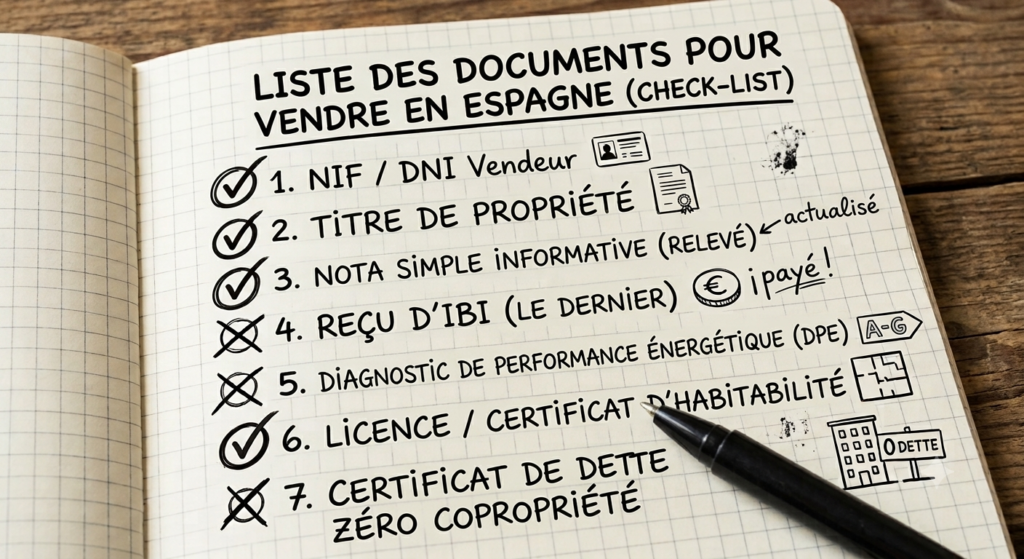
Selling a property in Spain isn’t just a matter of posting photos and a nice description on Idealista. It all starts several weeks before the listing goes live, when you begin gathering the documents needed to sell in Spain. That’s where most delays occur: a missing energy certificate, an outdated “ Nota Simple ,” or an expired “cédula de habitabilidad” can hold up a closing or discourage a buyer in a hurry.
This checklist therefore lists all the documents required to sell your property safely, whether it’s in Madrid, Valencia, or elsewhere in Spain.
Documents Needed to Sell a Property in Spain: What You Need to Know
Key Takeaways
- The escritura (title deed), the energy certificate, the seller’s DNI or NIE, and the most recent IBI (property tax) receipt are the mandatory requirements for any sale.
- Nota Simple s are not legally required, but the notary and the buyer always request them.
- Only certain regions require a certificate of occupancy (the Valencian Community, Catalonia, the Balearic Islands, Murcia, etc.), but not Madrid.
- A mortgaged property requires a debt balance certificate from the bank before the contract is signed.
- A nonresident seller is subject to a 3% withholding tax on the sale price and must then report the capital gain via the web Modelo 210.
Documents Required for a Sale in Spain: Common to All Sales
First of all, four documents form the essential foundation, regardless of the region or the type of property.
- The deed of sale. This is the title deed signed at the time of your purchase. If you have lost the original, simply request a certified copy from the notary’s office that filed the deed.
- The Energy Efficiency Certificate. Required for any sale or rental, it is issued by a certified technician and remains valid for 10 years. Its rating (from A to G) must be included in the listing, including on real estate websites. Without it, the listing itself is considered noncompliant.
- The seller’s DNI or NIE. If the property is owned by multiple people (joint ownership, estate, married couple), each owner must present their own valid ID. An expired ID can delay the signing at the last minute.
- The most recentIBI (Impuesto sobre Bienes Inmuebles) tax bill. Unless otherwise agreed, it is customary for the seller to pay the IBI portion up to the date of the sale.
Planning a sale in Spain?
The Terreta Spain team will assist you in preparing your sales documentation, whether in Madrid or Valencia, in collaboration with our partner notaries and attorneys.
Contact Terreta SpainNota Simple : Optional on Paper, Essential in Practice
Among the documents required for a sale in Spain, the Nota Simple holds a special place. Unlike the energy performance certificate, the Nota Simple—issued by the Registro de la Propiedad—is not legally required of the seller. In practice, however, the notary and the buyer always request it. This is because it verifies the property’s legal status: ownership, mortgages, liens, and registered easements.
Terreta's advice: Go ahead and order it even before it goes on sale. That way, you can verify that the information in the registry is up to date, and avoid any unpleasant surprises in the middle of negotiations.
The Certificate of Occupancy: A Requirement That Varies by Region
In fact, this is one of the points most often misunderstood by foreign sellers, whether they come from France, Belgium, the Netherlands, the United Kingdom, or the United States. The cédula de habitabilidad certifies that a dwelling meets the minimum habitability requirements. However, whether it is mandatory varies by autonomous community:
- Several regions require this, including the Valencian Community (in the form of a license or declaration of secondary occupancy), Catalonia, the Balearic Islands, Murcia, Navarre, Cantabria, Asturias, La Rioja, and Extremadura.
- It does not exist in Madrid. For a new or extensively renovated property, the licencia de primera ocupación or the equivalent sworn statement serves as its substitute; for an older property, the notary relies on the escritura and the energy performance certificate.
Another point to keep in mind: its validity is limited, generally to 10 to 15 years depending on the region. Therefore, in a region where it is mandatory, an expired cédula must be renewed before the sale, with the assistance of an architect or a technical architect.
Other documents required to sell property in Spain, depending on your situation
In addition to the common core requirements, other documents may be required depending on the property or the seller.
- If the property is mortgaged, you’ll need a certificate of outstanding debt (certificado de deuda pendiente) from the bank. There are two options: pay off the loan before signing, or pay it off on the same day using the proceeds from the sale. The latter is common practice; however, it requires careful coordination between the bank, the notary, and the buyer.
- If the property is part of a condominium, the notary will request a certificate of good standing (certificado de estar al corriente de pago), which confirms that there are no unpaid fees. You should therefore request this from the property manager, allowing a few days for processing.
- In the case of an estate or joint ownership. In such cases, additional documents are required (declaration of inheritance, acceptance of the estate, agreement of all co-owners), which extends the processing time.
- If you are a non-resident for tax purposes, the buyer withholds 3% of the price and pays it to the Spanish tax authorities as an advance payment. You then report the actual capital gain via the Modelo 210. Full details are available in our article on real estate sales taxation in Spain.
Recommended, but not required, documents
Furthermore, while the law does not require certain documents, they reassure the buyer and help them make a decision more quickly:
- Floor plans of the property, for example, so you can visualize the layout even before the tour.
- Installation certificates (electricity, gas), which certify that the installations comply with regulations.
- Recent utility bills (water, electricity, gas), which show that payments are up to date and facilitate the transfer of contracts.
Admittedly, none of these documents legally prevents a sale. However, their absence may give a cautious buyer—particularly a foreign or institutional buyer—pause.
How long does it take to gather the documents needed to sell a property in Spain?
In practical terms, if you’re starting from scratch, you should generally allow 3 to 6 weeks for preparation before you can post a listing with confidence. However, the timeframe is reduced to one week if you already have a valid escritura, energy certificate, and cédula. Conversely, it can take more than 2 months in cases involving an inheritance, a mortgage that needs to be paid off, or an expired cédula.
In short, best practice is to begin these steps as soon as the decision to sell is made, even before choosing a real estate agency or setting a price.
Timeline: When to Prepare Each Document
Checklist of Documents Needed to Sell Property in Spain
Sorted by requirement and preparation time
| Document | Status | To Prepare |
|---|---|---|
| Deed of Sale | Mandatory | Before Going on Sale |
| Energy performance certificate | Mandatory | Before the announcement was published |
| DNI / NIE | Mandatory | Verify validity in advance |
| Latest IBI receipt | Mandatory | Before signing |
| Nota Simple | Optional, but required in practice | Before Going on Sale |
| Certificate of Occupancy | Required depending on the region | Check validity |
| Certificate of Co-ownership | Required if it is a condominium | A few days before the signing |
| Mortgage Debt Certificate | Required if there is a mortgage | Plan Ahead with Your Bank |
| Blueprints, bulletins, invoices | Recommended | Before the First Visits |
This is a general checklist. The exact requirements vary depending on the autonomous community and the property’s circumstances: please confirm these with a partner attorney.
Prepare Your Sales Package with Peace of Mind
Terreta Spain identifies any missing documents, orders the " Nota Simple ," and coordinates with the bank, notary, and architect to ensure your file is ready before the first offer.
Contact Terreta SpainHow Terreta Spain Ensures the Security of Your Application
At Terreta Spain, the process of preparing documents for a sale in Spain begins with the very first interaction with a seller, well before the property is listed for sale. Specifically, we identify the documents you already have, order an up-to-date Nota Simple , and verify the cédula if required by the region. Finally, if there is a mortgage, we also coordinate the necessary steps with your bank.
By planning ahead, we can avoid last-minute setbacks, which are the leading cause of delays in sales in Spain. For the entire process, read our comprehensive guide to selling in Spain and our FAQs for sellers.
FAQ: Documents Needed to Sell a Property in Spain
Can you sell a property in Spain without a real estate Nota Simple ?
Legally speaking, yes, because it is not required of the seller. However, in practice, the notary and the buyer always request it, since it confirms the legal status of the property. It is best to order it before the property is listed for sale.
Is the certificate of occupancy required everywhere in Spain?
No. It is required in certain autonomous communities, such as the Valencian Community, Catalonia, the Balearic Islands, and Murcia. However, it is not required in Madrid. You must therefore check the regulations of the region where the property is located before preparing the application.
What happens if the energy certificate is missing?
The listing is noncompliant, since it must include the energy rating, and the seller is liable for an administrative penalty. The certificate must be provided to the buyer at the time of sale. Fortunately, it can be obtained in a few days from a certified technician.
How do you sell a property that is still under mortgage in Spain?
That’s entirely possible. The mortgage can be paid off before the signing, or on the same day using the proceeds from the sale—which is common but requires close coordination between the bank, the notary, and the buyer. In any case, a certificate of outstanding debt is required.
Conclusion
Documentation: The First Step Toward a Smooth Sale
Title deed, energy performance certificate, Nota Simple, and ID card (depending on the region): gathering the right documents to sell a property in Spain before listing it prevents the vast majority of complications. Terreta Spain supports its clients—both Spanish and international—from the very beginning of the process, whether in Madrid or Valencia.
Contact Terreta SpainFor more information: