
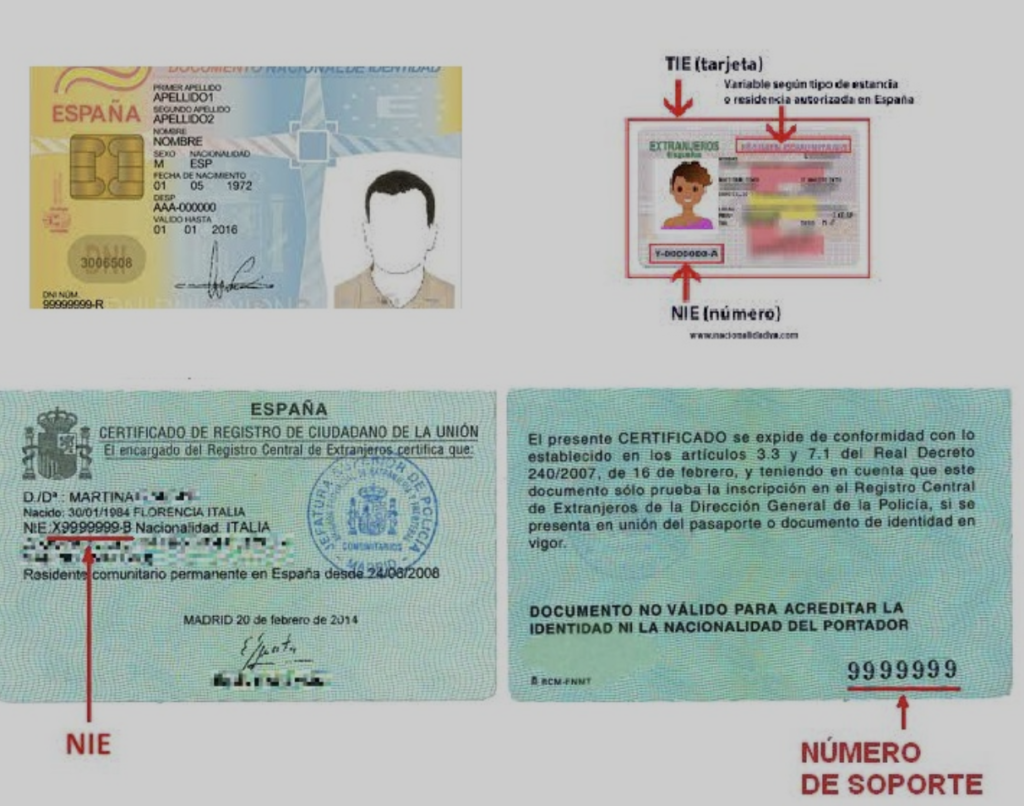
Spain attracts many expatriates every year. There are more than 5.5 million foreigners living in the country. To settle legally in the country, 3 documents are required: the NIE, the TIE, and the Residence Certificate. The one that suits you depends on your situation. Terreta Spain takes stock.
The NIE (Número de Identidad de Extranjeroor Foreigner Identity Number)
We have dedicated a complete article to it with extensive details, but let's go over the essential information to clearly compare these 3 documents.
The NIE is a number that allows foreigners to carry out administrative procedures and make financial transactions in Spain.
Main characteristics
- Target audience: any foreigner, European or not.
- Uses:
- Economic transactions, such as real estate investment
- Opening a bank account in Spain
- Business creation
- University enrollment
- Etc.
To launch your real estate investment project from home, make an appointment with the Terreta Spain experts.
Specificities
Please note, the NIE:
- Is not a physical card
- Is not an identity document
- Is valid for life (if you leave Spain and return 10 years later, your NIE number will be the same)
- Good to know: it can be obtained without leaving Spain
How to obtain it?
The procedure for obtaining it is detailed here, but let's summarize the 4 main steps:
- Make an appointment at the consulate or with the national police
- Fill out the EX-15 form, available by clicking on this link. Then the modelo 790 codigo 012 (to pay the tax of approximately €10 corresponding to the process)
- Provide the following documents:
- The reason for your request (for example: the purchase of a property in Spain)
- An identity document
- Note that documents written in a foreign language must be translated into Spanish by an official translator
The TIE (Tarjeta de Identidad de Extranjero or Foreigner Identity Card)
This document is not well known, but absolutely essential for non-EU nationals who choose to reside in Spain. It is their identity card.
Main characteristics
- Target audience: non-Europeans who stay more than 6 months on Spanish territory. Please note: since Brexit, British citizens must apply for a TIE.
- When to apply? Within 30 days of arrival in Spain.
- Validity: The TIE is valid for 5 years.
- What does this document contain?
- The holder's personal information
- Their photo
- Their fingerprints
- Their NIE number
How to obtain it?
- It is essential to have a valid NIE.
- Make an appointment at the consulate or with the national police.
- Fill in form EX-17 or form EX-23 if you are a British citizen.
- Pay the fee of between €12 and €15 depending on your situation (check the amount that applies to you on this link) and complete the modelo 790 codigo 012.
- Provide:
- Identity photo
- Supporting documents
- Remember to have your documents translated into Spanish by a certified translator.
The EU Residence Certificate (Certificado de Registro de Ciudadano de la UE)
This document concerns citizens of the EU or the European Economic Area who wish to reside in Spain for more than 90 days.
Main characteristics
- It is often called the "Spanish Green Card" because it is a small business card-sized paper, green in color.
- It has unlimited validity; the document does not need to be renewed.
- It serves to confirm the status of European resident.
How to obtain it?
- You must reside in Spain for at least 3 consecutive months.
- It is absolutely necessary to justify your status and the reason for your expatriation: studies, work, retirement, etc.
- Fill out the EX-18 form.
- Pay the corresponding fee of €12 and complete the Modelo 790-12.
- Provide the requested supporting documents and ensure that they are duly translated into Spanish.
Practical advice from our experts
Keep in mind that:
- Each member of a family must apply for an NIE, TIE, or Residence Certificate.
- Do not forget that your documents must be translated by a certified professional.
- Administrative delays can be very long. Take this into account.
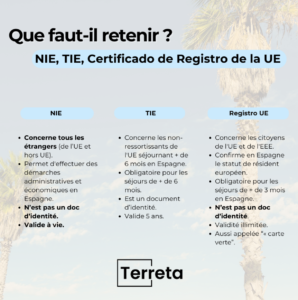
FAQ: NIE, TIE, and Residence Certificate
What are the timeframes for receiving your NIE, TIE, or Residence Certificate?
For the NIE, you can expect 2 to 4 weeks. For the TIE, the administration announces a maximum processing time of 45 days. Regarding the Residence Certificate, it can be immediate, during the official appointment you will have made online.
Can you invest without an NIE?
It will be impossible for you to buy or rent a property without an NIE.
Is the Certificado de Registro de la UE renewable?
No, it is valid for life.
Does an American citizen need an NIE or a TIE?
Both: the NIE is necessary to carry out administrative procedures in Spain (even for non-residents) and the TIE is necessary if you live in Spain for more than 3 months (residence or work).
Conclusion
NIE, TIE or Certificado de Registro de la UE, understanding the difference between these 3 documents is essential to the success of your investment and/or your expatriation to Spain. Arm yourself with patience and be precise in your procedures to avoid any disappointment. If in doubt, Terreta Spain advises you to turn to a specialized lawyer. Contact us to be put in touch with experienced and multilingual professionals.
Sources