
Terreta Spain, updated in May 2026
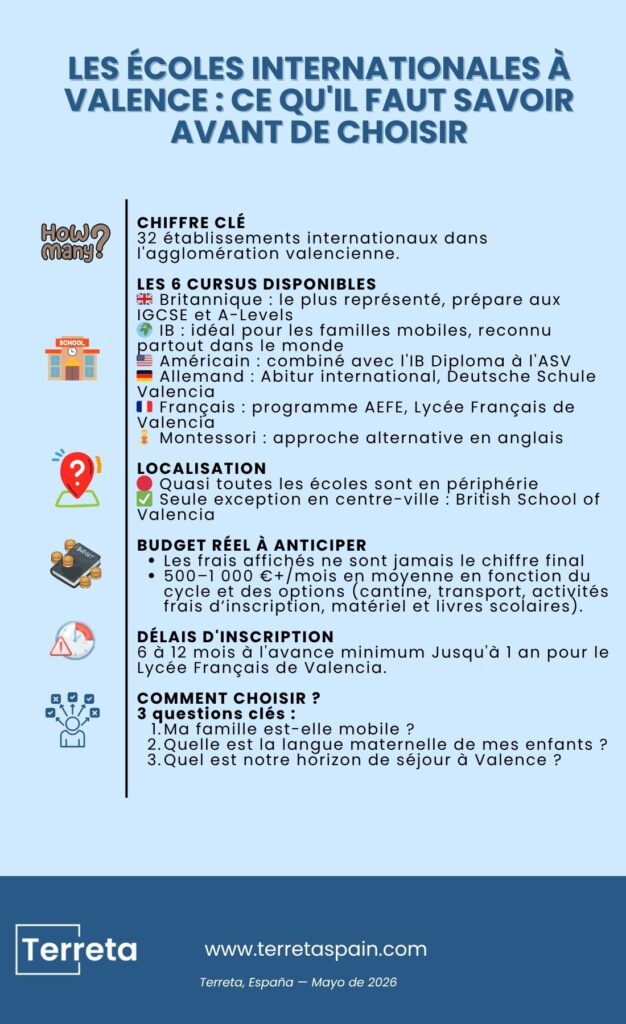
In just a few years, Valencia has become one of Europe’s most attractive cities for expat families. Its climate, cost of living, and quality of life have drawn a wide variety of communities, including British, American, French, German, and Dutch families. These families benefit from a remarkably diverse range of international schools. There are currently 32 international schools in the Valencia metropolitan area.
The Terreta Spain guide to international schools in Valencia helps you understand the different programs available, compare the leading schools, and make a choice based on your family’s situation.
The different types of institutions
Before making a decision, it is important to understand the main types of programs available in Valence.
The British curriculum in Valencia
The British curriculum (National Curriculum for England) is by far the most common in Valence. It prepares students for the IGCSE (International General Certificate of Secondary Education, the equivalent of the brevet in France) and then for the A-Levels (the baccalauréat), which are recognized worldwide. It is the natural choice for English-speaking families and many European families who want their children to be educated in English.
British School of Valencia (BSV)
Founded in 1992 and located in the heart of Valencia, the British School of Valencia is one of the few English-language schools that is truly accessible without a car from the city center. It serves students aged 2 to 18 across two campuses: the main campus for students aged 2–16, located on Peris y Valero Avenue in the Ruzafa neighborhood, and BSV Nexus, dedicated to students aged 16–18, just a few hundred meters away.
The curriculum follows the English National Curriculum, with IGCSE exams at the end of secondary school and A-Levels. Students earn a dual diploma: the British A-Level certificate and the Spanish Bachillerato, recognized by Spanish and international universities. Academic results are strong: in 2024–2025, 84.1% of students achieved grades 7–9 in IGCSE (equivalent to A), and 54.4% achieved A grades in A-Levels.
Cambridge House British International School
Founded in 1986 and located in Rocafort, about 13 kilometers north of Valencia, Cambridge House is one of the most renowned British schools in the Valencia region. It was the first school in Spain to simultaneously obtain BSO (British School Overseas) status and NABSS (National Association of British Schools in Spain) accreditation, two designations that certify the educational excellence of a British school outside the United Kingdom. It has been part of the international education group Globeducate since 2021.
The school serves approximately 1,700 students aged 3 to 18 and follows the English National Curriculum from the Early Years Foundation Stage (EYFS) through to A-Levels. Upper-school students also have access to BTEC programs, a more vocational track recognized by British universities. Students are fully immersed in English from the moment they start at age 3, supplemented by Spanish, Valencian, and other languages depending on their level: French, German, or Italian.
Its Rocafort campus, located in a quiet residential area, offers sports facilities and outdoor spaces that few downtown schools can match. For families who do not live nearby, the school is accessible by private vehicle, with two parking lots available.
The International Baccalaureate in Valencia
The International Baccalaureate (IB) is offered by several schools, either as a supplement to the British curriculum or as a comprehensive program (PYP, MYP, DP: elementary, middle, and high school). It is ideal for families who move frequently, as it makes transitions between countries easier.
Mas Camarena
With over 28 years of experience, Mas Camarena is the only school in Valencia offering all four active IB programs (PYP, MYP, DP, and CP) for students aged 0 to 18. Located in Bétera, northwest of Valencia, the campus spans over 100,000 square meters. It is the top choice for families who prefer the IB from preschool through high school.
The American curriculum in Valencia
American School of Valencia
The school combines the standard American curriculum with the IB Diploma at the end of the program, offering dual accreditation recognized by American and European universities. It welcomes a diverse international community and is distinguished by its strong multicultural approach.
The German program in Valencia
The German International School in Benimaclet serves students aged 3 to 18 and features a campus of approximately 14,270 square meters, which will be expanded in 2026. It prepares students for the International Abitur (DIA). Instruction is provided in German and Spanish, with English introduced starting in 7th grade. It is primarily aimed at German-speaking families but also welcomes international students.
The French curriculum in Valencia
French High School of Valencia
The French curriculum is taught at the Lycée Français de Valencia, which is accredited by the French Ministry of National Education and operated under the supervision ofthe AEFE (the Agency for French Education Abroad). This means that the curriculum, class schedules, and diplomas are all modeled after those in France. Some children of the Terreta Spain team are enrolled at the French high school
The Lycée Français de Valencia (LFV) serves students from preschool through 12th grade.
A few important things to know before applying:
- French students are given priority for enrollment but make up less than 20% of the student body; more than 80% of the students are Spanish, drawn by the reputation of French education. In practice, therefore, the environment is less immersive in French than one might think. Valencian is taught starting in 8th grade, and some classes are taught in Spanish to facilitate integration.
- The school is undergoing significant changes. The growing influx of English-speaking expat families and the general demand for English are prompting the LFV to gradually strengthen the role of English in the curriculum. The school is slowly shifting toward a more international profile, without, however, abandoning its French identity. This is a trend to watch for families who choose this school precisely because of its roots in the French educational system.
- Scholarships are available to French citizens, subject to certain conditions. The application deadlines are very tight: it is recommended that you apply a year in advance, or even earlier for certain classes.
Montessori in Valence
The Montessori approach is offered by several small schools, including Imagine Montessori School and Mammolina Montessori International School.
The school follows the British curriculum, guided by Montessori principles, for children aged 20 months to 18 years. It is particularly well-suited for families seeking an alternative educational approach in an international setting.
Do you want the school and the neighborhood of your future home to be a perfect fit? Contact Terreta Spain, and we’ll work with you to build your project.
A private school with an international focus: Colegio Internacional Ausiàs March
The Colegio Internacional Ausiàs March is often overlooked by expat families arriving in Valencia, which is a shame. Founded in 1972 and located in Picassent, about 20 minutes from downtown Valencia via the A-7 or V-31, this private, secular school offers a bilingual Spanish-English curriculum with 50% of classes taught in English starting in preschool and more than 45% in elementary school.
What sets it apart is its commitment to the IB program: the Diploma Programme has been offered since 2016, and the MYP was authorized in 2024, making it one of the few schools in the region to offer a full IB sequence from middle school through high school. It is also an official Cambridge exam center, holding the Cambridge Advantage Premium distinction—one of only eight schools in the entire Valencia region to hold this designation. It has also been recognized by Forbes 2026 and is listed inEl Español’s ranking of the 30 most innovative schools in Spain.
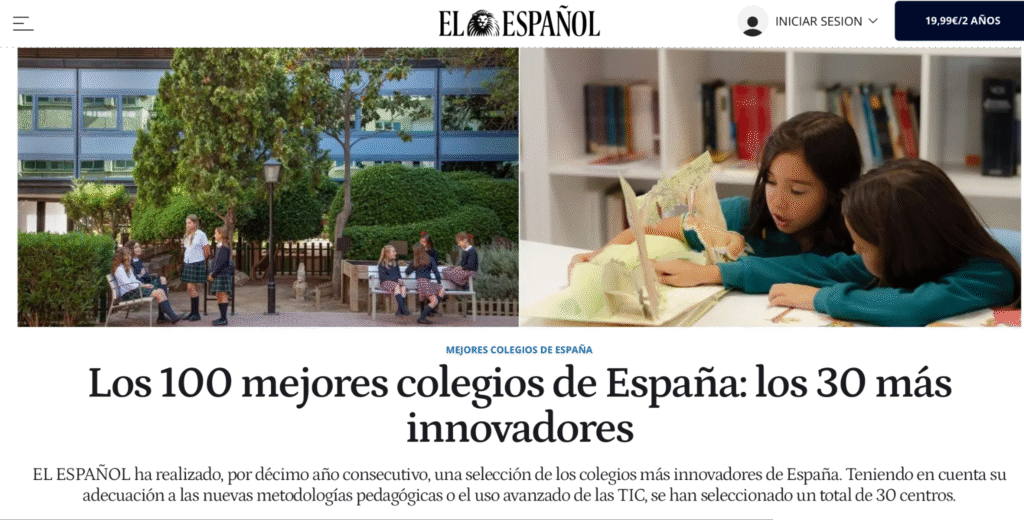
Since 2024, the school has been part of the international education group Affinitas Education, which has strengthened its international presence and educational resources.
For families who do not wish to live in the suburbs, the school operates more than 15 bus routes from downtown Valence and the surrounding metropolitan area. Tuition is significantly lower than at the region’s major British schools, making it a strong option for families seeking a challenging international environment with a recognized IB program, without breaking the budget of the most established schools.
A budgetary reality to anticipate
Attending an international school in Valencia is a major expense, regardless of which program you choose: British, American, IB, or French.
At most schools, you should expect to pay between €6,000 and €9,000 per year per child, which often amounts to €500 to over €900 per month, depending on the school and grade level. The fees listed on websites generally cover only basic tuition: costs for the school cafeteria, school transportation, supplies, extracurricular activities, and registration or re-registration fees are added on and can significantly increase the final bill.
This is a factor that should be factored into the overall cost analysis of your move to Valence from the very beginning, just like rent, health insurance, and taxes.
Comparison Table by Program and Tuition Fees
| Establishment | Curriculum | Primary language | Ages | Location | Estimated annual fees* |
| Mas Camarena | Full IB (4 programs) | Spanish / English | Ages 0–18 | Bétera | approx. €300–700/month |
| American School of Valencia | American + IB Diploma | English | Ages 3–18 | Puçol | ~€6,900–€8,900 per year, including meals, depending on the level |
| German School of Valencia | International Abitur | German / Spanish | Ages 3–18 | Benimaclet | Upon request |
| French High School of Valencia | AEFE French Program | French / Spanish | Ages 3–18 | Valencia | Approx. €4,800–€5,800 per year |
| Imagine Montessori School | British + Montessori | English | 20 months–18 years | Valencia | Approx. €8,300/year |
| Caxton College | British National Curriculum | English | Ages 1–18 | Puçol | ~€6,600–€9,600 per year, including meals |
| El Plantío | British + IB | English | Ages 2–18 | La Cañada | Approx. €6,500–8,300 per year, depending on the program |
| Ausiàs March | IB (MYP + Diploma) | Bilingual in Spanish and English | Ages 3–18 | Picassent | €439–877 per month, depending on the level |
| British School of Valencia | British + A-Levels + Bachillerato | English | Ages 2–18 | Downtown Valencia | Upon request |
| Cambridge House | British + A-Levels + BTEC | English | Ages 3–18 | Rocafort (13 km) | Upon request |
The fees listed in the table are for the 2025–2026 academic year. Please contact each institution directly for current rates.
How to choose an international school in Valencia?
The choice depends mainly on three factors:
- Your family's mobility
- Your children's native language
- Your stay in Valencia.
If you plan to stay in Spain long-term, a program leading to a Spanish high school diploma (Bachillerato) makes it easier to gain admission to local universities. If you move around frequently, the IB is the most widely accepted academic credential. If your children are already in the French or German school system, continuing their education at a school offering the same curriculum will help minimize the transition.
For French-speaking families who wish to continue with the French curriculum, the Lycée Français de Valencia is the obvious choice. However, you need to plan for enrollment well in advance.
Are you planning to move to Valencia with your children? Terreta Spain can help you with housing, renovations, and neighborhood life.
Directory of the international schools listed
To contact the establishments listed in this guide directly, please use the contact information below.
Mas Camarena – Mas Camarena Educational Complex (IB)
- Website: colegiomascamarena.es
- Phone (switchboard): +34 96 168 60 20
- Email (general contact): info@edicinco.com
American School of Valencia (American curriculum + IB)
- Website: asvalencia.org
- Phone (switchboard): +34 96 140 54 12
- Email (admissions / contact): asvalencia@asvalencia.org
German School of Valencia (German curriculum)
- Website: dsvalencia.org
- Phone: +34 963 690 100
- Email: dsvalencia@dsvalencia.org
French High School of Valencia (AEFE)
- Website: lfval.net
- Phone (switchboard): +34 96 136 40 47
- Email (Admissions): admissions@lfval.net
Imagine Montessori School (British + Montessori)
- Website: imaginemontessori.es
- Phone (switchboard): +34 96 314 51 02
- Email (administrative contact / data protection): dpd@imaginemontessori.es
(For admission applications, we generally prefer the forms available on the website.)
Caxton College (British curriculum)
- Website: caxtoncollege.com
- Phone (front desk): +34 96 142 45 00
- Email (general): caxton@caxtoncollege.net
- Email (Admissions): admissions@caxtoncollege.net
El Plantío International School of Valencia (British + IB)
- Website: plantiointernational.com
- Phone (switchboard): +34 96 132 14 10
- Email (office / contact): secretaria@plantiointernational.com
Ausiàs March International School (IB + Spanish-English bilingual)
- Website: ausiasmarch.com
- Phone: +34 961 23 05 66
- Email: info@ausiasmarch.com
British School of Valencia (British curriculum)
- Website: bsvalencia.com
- Phone (Admissions): +34 678 006 034
- Email: via the admission form on the website
Cambridge House British International School (British curriculum)
- Website: cambridge-house.britishinternationalschool.com
- Phone: +34 963 90 50 19
- Email: recepcion@cambridgehouse.es or via the contact form on the website
This guide is provided for informational purposes only. Fees and programs are subject to change. Please contact each institution directly for the most up-to-date information.
Need help finding the right school, neighborhood, and budget for your home in Valencia? Every year, the Terreta Spain team helps French, Belgian, and international families settle into life in Spain. Tell us about your plans, and we’ll help you find the school, neighborhood, and type of property that best suit your needs.
For more information, check out our articles:
- The steps involved in buying property in Spain
- How do I get my NIE?
- Mortgages in Spain?
- The most profitable neighborhoods in Valencia
- The Ultimate Guide to Valencia's Neighborhoods
FAQ: International Schools in Valencia
When should I enroll my children?
Start the process 6 to 12 months before the school year begins, ideally as early as January for a September start. Private schools accept applications year-round, but spots fill up quickly in the most sought-after grade levels and in popular areas like Rocafort or Puçol. For the Lycée Français, pre-registration opens every spring via the Eduka platform. Deadlines are tight and French students are given priority, but spots remain limited even for them. If you’re moving from abroad during the school year, most schools accept applications at any time: explain your situation from the very first contact; this makes the process easier.
What documents are required?
The list varies by school, but the following documents are required in almost all cases: school transcripts from the past 2 to 3 years, the child’s passport or ID card, birth certificate, up-to-date immunization record, and a reference or report from the previous school. Some schools also require a letter of motivation from the parents or a preliminary interview. Please note: certain documents must be officially translated into Spanish by a certified translator, particularly for families from outside the EU. Plan ahead for these steps, as they can take several weeks.
Does my child need to speak the language of the school?
In preschool, the vast majority of schools do not require any prior language proficiency: children adapt naturally through immersion. Starting in elementary school, a certain level of English is generally required for admission to British, American, IB, and Montessori programs. For the Lycée Français de Valencia, no test is required for French-speaking students. The Deutsche Schule Valencia organizes a trial day to assess the child’s ability to adapt. If your child does not yet speak the school’s language, please indicate this on the application form: most schools offer language support either in class or through separate sessions.
Can I enroll my child during the school year?
Yes. International schools in Valencia generally accept mid-year admissions, especially for families arriving from abroad. In fact, this is a common situation: expats don’t always time their arrival to coincide with the Spanish school calendar. The American School of Valencia goes a step further and offers remote assessments for families who haven’t yet arrived. The Lycée Français de Valencia also accepts mid-year admissions, subject to availability in the relevant grade level. In any case, contact the school directly as soon as your arrival date is known.
Are all international schools located far from the center of Valencia?
Almost. This is one of the first surprises for families arriving in Valencia: the vast majority of international schools are located on the outskirts. Puçol to the north, Bétera to the northwest, Rocafort, Paterna, La Cañada… The only notable exception among the major schools is the British School of Valencia, whose two campuses are located right in the city center, in the Ruzafa neighborhood. For all the others, you’ll need to rely on school transportation organized by the school, a personal vehicle, or choosing a place to live near the school. If you haven’t yet decided on a neighborhood to live in, it’s often easier to choose the school first, then look for a place to live within its catchment area.
How much should you budget for tuition at an international school in Valencia?
That’s the question everyone asks, and the honest answer is: more than the listed fees suggest. At most schools, basic tuition ranges from €6,000 to €9,600 per year, depending on the school and grade level—that’s €500 to €900 per month. But this figure generally covers only tuition: the cafeteria, school transportation, supplies, extracurricular activities, and registration fees are added on and can increase the bill by several hundred euros per month. The Lycée Français de Valencia is the most affordable option on the list, with listed fees ranging from €4,800 to €5,800 per year, but the actual cost comes to around €600 to €700 per month all-inclusive. In contrast, some British or IB schools can exceed €1,200 to €1,500 per month per child once all additional fees are included. Be sure to factor this expense into your relocation budget from the start, just as you would rent. Want to take stock of your school and real estate plans in Valencia in just 30 minutes? Schedule a call with Terreta Spain.